Warning Track
A location-tracking tool commonly licensed to law enforcement allows users to track devices that visit sensitive locations, Notus reports.
Atlas Privacy, a startup that helps consumers remove their data from data broker sites, recently analyzed a location-tracking tool called Locate X developed by data broker Babel Street. Locate X allows users to search for mobile devices that have visited specific locations – including abortion clinics, courthouses, schools and homes.

Using Locate X, Atlas researchers tracked more than 700 individual devices that had visited an abortion clinic in Florida, as well as the likely home addresses of the device owners. In some cases, they observed how these devices traveled to the clinic over state lines.
Law enforcement having access to a service like this raises civil rights concerns in post-Dobbs America.
Although Babel claims to anonymize this data, Atlas found that it could easily be tied to individuals using commonly available people-finding and address-lookup tools. Atlas also found that the data was being sold in a largely unregulated market, with little oversight over who had access.
Heads-up to the FTC, which has been cracking down on the resale of location data.
And user consent may not be a shield in this case. Notus contacted multiple people whose devices had been tracked by Atlas via Locate X, and many felt they’d never consented to this degree of tracking.
Ghosts In The Machine Learning
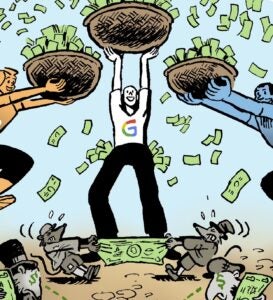
The black boxes are getting a little more transparent – but the slippery slopes are also getting more slippery.
Which is a poetic way to say Google and Meta just updated their AI-controlled ad products, adding important campaign controls at the ad level, negative search keyword suppression and new AI-generated creative production.
Google already rolled out its changes systemwide for Performance Max, including a way to automatically flip and crop video ads for any YouTube format.
Meta, meanwhile, quietly slipped by an “automatic adjustments” update that affords it wider license over advertiser accounts, including the ability to scale budgets or consolidate accounts [H/t @RokHladnik].
But what are framed as handy advertiser tools are actually – of course – all about monetizing the platforms.
It’s all too easy for advertisers to slip into PMax or Advantage+ Shopping Campaigns. Opting in is often positioned within the UI as an innocuous “best practice” or new optimization tool promising a performance lift.
Advertisers may have no idea they’ve agreed to a dramatic overhaul to how their marketing works, and are now automatically signed up for other changes they wouldn’t approve if they’d had a more transparently presented choice.
Vote With Your Dollars
If you’ve ever given a political group your phone number or email address, you’ve probably received some truly wild messages in return – the kind that urge YOU to give MORE before it’s TOO LATE to save AMERICA.
Most of us probably ignore those messages. But you know who doesn’t? People with dementia.
According to an interactive report from CNN, deceptive political fundraisers have extracted millions from unsuspecting elderly Americans, many of whom get tangled up in difficult-to-cancel recurring donations through ActBlue or WinRed.
Some donors in cognitive decline even walk away thinking they’ve been in direct contact with the politicians themselves, confused by messages written in a phony first-person POV.
These predatory tactics became a source of contention during the 2020 election, but in the years since they’ve gotten considerably worse, particularly on the Republican side.
The FTC has condemned certain practices that contribute to this phenomenon, but it doesn’t appear to have jurisdiction over ads used by political campaigns.
Which means it’s up to lawmakers or individual attorneys general – whose own careers are directly impacted by political fundraising efforts! – to crack down instead. Great system we’ve got here, huh?
But Wait, There’s More!
WPP returned to growth in Q3 after several down quarters. [WSJ]
Tensions rise as the World Federation of Advertisers grapples with Musk’s GARM lawsuit, splitting members. [Digiday]
Fox majorly restructures its ad sales team. [Adweek]
An AI researcher who left OpenAI in August says the company violated copyright law in training ChatGPT. [NYT]
You’re Hired
BlueConic hires Geana Barbosa as CRO. [release]
Vistar adds Sean Cheyney as its first-ever head of retail media. [release]