
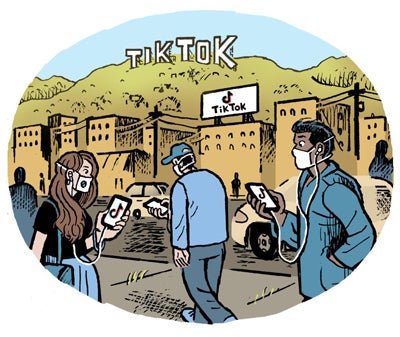
BigTok Is Watching
January 19 marked the anniversary of the federal deadline for supposedly banning TikTok in the US.
Now, almost exactly one year to the day later, TikTok signed a deal to divest its US business.
Per TikTok’s press release, a joint venture will be managed by a consortium of three investors: American PE firm Silver Lake, enterprise software company Oracle and Emirati investment firm MGX.
Cool, cool, but what about the data?

TikTok also updated its Terms of Service and Privacy Policy to inform users that it will be collecting “new types of information,” including device geolocation.
What has users really freaking out, though, is a clause stating that the app will also collect any information they disclose about their race, religion, health, sexual orientation, gender identity and citizenship or immigration status.
Interestingly, this language was likely added in July 2024, which is before President Trump returned to office. It’s also worth noting that TikTok’s current EU privacy policy doesn’t include similar language.
In a political climate defined by crackdowns on immigrants and people of color, often tied to location data, this update carries new weight. And the fact that TikTok now counts a Dubai-based investor among its co-owners only complicates the picture further and raises tough questions.
The Publisher Forecast
In a plea for on-site engagement, Forbes will offer rewards to users who correctly predict real-world outcomes, such as news, sports, weather and the like. The offering, called ForbesPredict, launches in beta next month, Digiday reports.
Forbes says the feature isn’t gambling but, rather, “gamification.”
For one, people don’t wager real money. And unlike prediction market platforms such as Kalshi or Polymarket, Forbes pays out in “tokens,” which readers will apparently want because they’re cool or something? By accumulating tokens, readers can bet on additional events.
It’s unclear how else Forbes will provide value for the tokens, since paying out cash or even tangible rewards could push it into murky legal territory as a form of gambling.
One thing is clear, however: Forbes wants to attract – and retain – engaged visitors by gamifying its journalism. And better engagement means more first-party data on consumer sentiment for ForbesOne, the data platform Forbes launched in 2021.
Forbes also plans to capitalize on brand sponsorships. A food or beverage brand, for example, could sponsor an interstitial prompting site visitors to predict the flavor of its next product.
Who wants to bet whether anyone participates?
More Like Business Outsider
All signs point to Business Insider CEO Barbara Peng’s advertising- and subscription-centered turnaround plan not panning out, reports Status.
A slew of executive leaders have recently departed.
The latest to exit is CRO Maggie Milnamow, who joined Betches Media last week after a last-minute reversal on a scheduled appearance at the World Economic Forum. BI took the opportunity to announce that Orlando Reece, global head of sales, is likewise making his exit.
Since November, BI’s head of subscriptions, Katie Friedman, and Priscilla Ellington, VP of live events, have also bounced. Not to mention Kaleigh Mountain, VP of ad sales, and Ryan Riefenhauser, an account director, who both joined Apple, while Maria Purcell, VP of global partnerships, left for Reach PLC.
What’s behind all the turnover?
Well, BI and parent company Axel Springer missed their revised 2025 revenue targets. And Peng – who was hired in 2023 – told employees in a recent all-hands meeting that BI struggled on advertising, subscriptions and partnerships last year.
More layoffs aren’t expected, however, since BI cut staff by 21% last year. Such is life in the news biz.
But Wait! There’s More!
As part of the new corporate takeover, TikTok Shop will end independent shipping for US brands. [Adweek]
Why does Google keep replacing news headlines with (terrible) AI-generated versions? [The Verge]
Gen Zers use generative AI the most but are more anxious about the technology than older generations. [Business Insider]
With Meta leading the pack, Big Tech companies spent $109 million lobbying the Trump administration last year, topping $100 million in lobbying for the first time. [Bloomberg]







