
 “Brand Aware” explores the data-driven digital ad ecosystem from the marketer’s point of view.
Today’s column is written by Mayur Gupta, global head of marketing technology and innovation at Kimberly-Clark.
Much of what has been written about omnichannel experiences reflects two perspectives. The first: Every consumer expects it and every brand wants to deliver it. The second: It is still unreal and far from being a reality.
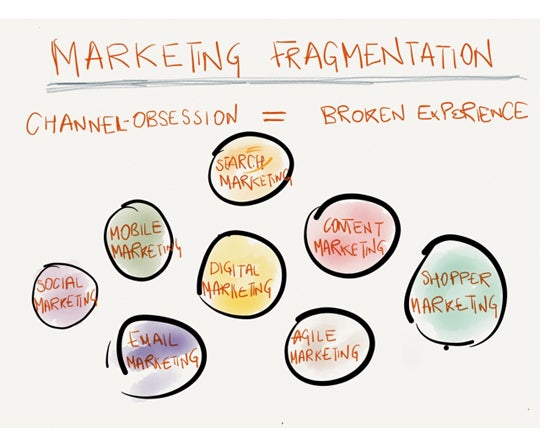
Few brands and marketers, however, have actually deployed successful omnichannel strategies. The reason is simple: We are operating within an increasingly broken and fragmented ecosystem that is channel-focused and not centered on the consumer.
Shifting to a world where true omnichannel strategies can thrive will require fundamental change. Underpinning these changes are what I call the first principles of an omnichannel strategy. Here they are, in no particular order.

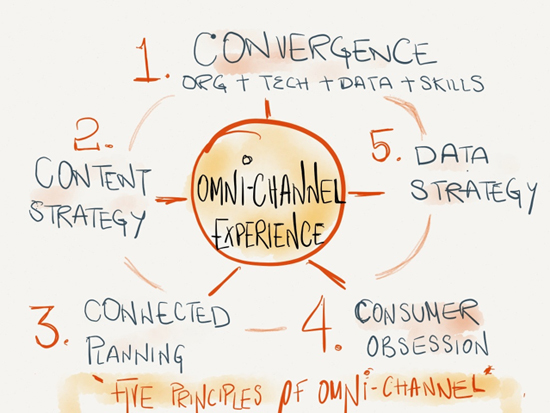 Drive Convergence, On All Levels
Organizational convergence is perhaps the most fundamental but challenging change because it requires a shift in culture and mindset. We need to breakdown silos across marketing, sales, technology and finance to ultimately ensure a common set of goals and objectives centered on the consumer experience.
The convergence of data is essential, including first-party, second-party and third-party data across paid, owned and earned media, as well as social, shopping and behavioral data. We must create an environment where data is the glue that connects the consumer journey together across her ecosystem, leveraging a universal view and understanding of the consumer to make seamless experiences a reality.
Technology must also converge. In any vertical, technology provides strength and power, but with power comes responsibility. We continue to run away with the power without taking the responsibility to apply it correctly. We end up becoming a hammer in search of a nail. We need to use technology to deliver experiences and change consumer behaviors, while avoiding isolated pieces of excellence that don’t add any value.
To manage all of this, we must focus a convergence of skills. We need the DNA of the modern marketer, the unicorns at the intersection of marketing, technology, data, content, creative and storytelling. We need people who break the traditional T-shaped mindset and go wide and deep across functions. I call them pi-shaped marketers.
 Content Strategy
Developing a holistic content strategy helps you deliver the right content to the right consumer, with the right context at a time and touch point of his or her choice.
Content, along with data and technology, are the only channel-agnostic linchpins that can drive an omnichannel experience. Using data and context to make content more relevant, personalized and contextual to the consumer is an absolute must. Content delivers the final punch with an immersive and seamless consumer experience, inspiring behavioral change through participation.
 Connected Planning Using Content, Data And Technology
Establish a planning process that inspires data-driven marketing and connecting content, data and technology with a central focus on the consumer. It’s breaking away from the traditional planning constructs, which are “channel-driven,” to basing the plans and strategies on data and consumer insights, which are used to determine the right content across the consumer journey, focusing on inflection points where a change in a consumer’s behavior is required.
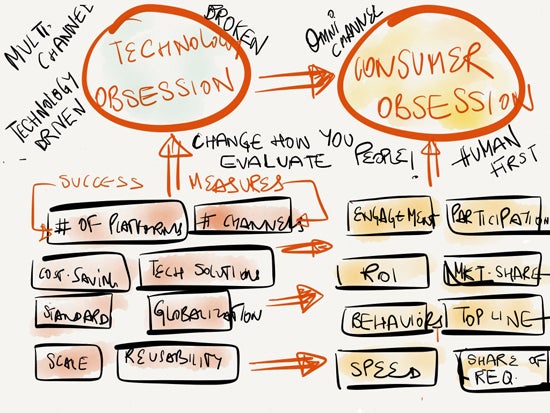
 Shift The Obsession With Technology And Channels To Consumers
Ultimately, we need to change the way we measure success for people. Should it be about great technology solutions, driving cost saving and scale or driving consumer experiences and inspiring participation and behavioral changes, which will eventually lead to top-line growth?
Unfortunately, we continue to reward behaviors that put channel and technology before the consumer. Unless we establish these consumer-focused goals as a common vision and measure of success for everyone, we will continue to see isolated and broken experiences.
 Data Strategy
Lastly and, perhaps, most importantly, we must establish a data strategy that focuses on data harmonization and convergence. Data is the linchpin that stitches the consumer journey together. It is the only signal we receive from consumers as they move from one touch point to the other. The ability to learn from these signals and understand a consumer’s individual emotional and functional needs, while transforming all this data into insights and taking action seamlessly across channels, will ultimately lead to an omnichannel experience, with the consumer at the center.
 Ironically, while as an industry we have been talking about our omnichannel dreams for a while now, the only component of the ecosystem that is truly operating and behaving in an omnichannel way is the consumer. Everyone else is multichannel at best.
While these five principles may not be all that is needed to become omnichannel, these are certainly fundamental to even begin embarking on that journey. Otherwise, omnichannel will remain an abstract theory.
Follow Mayur Gupta (@inspiremartech) and AdExchanger (@adexchanger) on Twitter.








