
 Google is giving advertisers and agencies up-to-the-month access to its industry performance benchmarks for display advertising. Called Display Benchmarks, the tool presents aggregated ad performance data that can be filtered according to variables such as click-through rates, ad interaction times, video completion rates, and other metrics. And it works across ad formats/sizes (including mobile), verticals and regions.
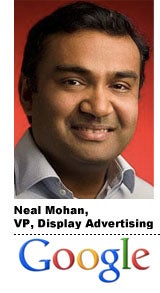
Google has produced such benchmarking before, but only on an annual basis, Neal Mohan, Google’s VP of display, told AdExchanger. The idea here is that advertisers will be able to take their own metrics – from any and all other data sources they use – and match it against the rest of the industry to provide a greater context for their performance right now.
“I don’t think there’s an agency or advertiser out there that wouldn’t welcome more access to benchmarks,” Mohan said. “In the past, this has been something that we produced as a yearly report, but we wanted to offer a real-time tool for today’s real-time world. Our hope is that our partners find this broadly useful across all their campaigns.”

Google has held its own against Facebook as the top recipient of display dollars for the past two years, when the two muscled Yahoo out of its long-held display leadership position. According to eMarketer figures, in all digital display, including desktop revenue, Google’s share of the $14.98 billion US market is 15.1%, compared to Facebook’s share of 14.6% last year. This year, Google and Facebook will see their shares of US display ad revenue grow to 17.6% and 15.5%, respectively.
But given the closeness of the competition, plus possible signs of resurgence at Yahoo and Aol in the display space, Google can’t afford to rest on its laurels.
Meanwhile, marketers and agencies are complaining louder about drowning in “big data” while lamenting the seeming lack of “smart data.” Google is looking in part to improved measurement and related tools to maintain its advertising hegemony across both search and display.
Last month, for example, Google trumpeted the Media Ratings Council’s accreditation for its viewability metrics. Still, asked if the display benchmark tool is best seen as a complement or an additional layer to the myriad other analytics tools Google offers, such as YouTube’s TrueView or its standalone engagement metrics, Mohan says this should be considered separately.
“Many companies use our analytics tools – and others – to understand performance of their campaigns and sites,” Mohan said. “It’s much harder, though, to get reliable access to benchmarks for some of the key metrics, like video completion rate or CTR. This is meant to help address that.”
In a snapshot that Google provided with a blog post, people are interacting with ads 50-60% more frequently and spending 20-30% more time interacting. An advertiser looking for more specific data that applies to their business can use the benchmarking tool to focus on their geographical region and compare and contrast their performance more closely to how other campaigns are performing.
In other words, since these are DoubleClick benchmarks, they’re based on data from campaigns across the web, not just Google’s own properties, Mohan noted when asked about the company’s other specific data offerings. In terms of how agencies and marketers should use the display benchmarks, Mohan said it is meant to provide a broad understanding of what’s happening beyond any one format.
“That said, I think in spirit they are a complement. With better measurement, advertisers can design their campaigns around engagement, which is also our goal with formats like True View and engagement ads,” Mohan added. “Measurement, generally, is a huge focus for us this year so stay tuned for more to come on this front.”









