When ChatGPT launched ads, the format was nothing novel.
While the release itself drew plenty of attention (in our universe, a major AI platform launching ads is sort of like when a new Taylor Swift album drops in the real world), the ads themselves were designed to be unobtrusive and familiar, similar to search ads.
As consumers grow more accustomed to ads in ChatGPT, what will the future of AI-native advertising look like?
The future is chat
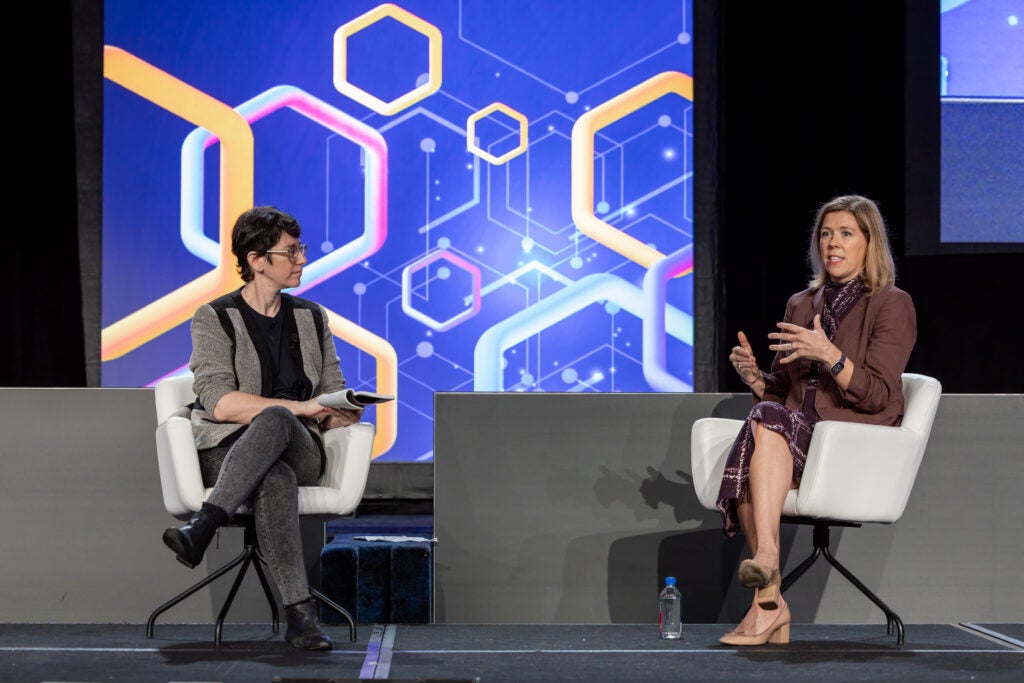
OpenAI is confident in its answer. “The future around an AI-native advertising experience” will be sponsored agents, Colleen Coulter, global ad solutions lead at OpenAI, said on Monday during a session at AdExchanger’s Programmatic IO in New York.
Earlier this month, ChatGPT launched Sponsored Agents, a new ad format that allows users to chat directly with a brand-sponsored agent after they click into an ad.
The brand determines the knowledge base, like a product feed or a help center, the agent relies on to produce answers, ensuring the responses are accurate and brand-safe.
The idea behind the new format comes from increasing consumer demand for – and expectation of – “natural conversational [experiences],” Coulter said.
A couple of weeks before Sponsored Agents were announced, ChatGPT also announced a custom audience feature, allowing audiences to target specific customers or prospects using email addresses, phone numbers, hashed email addresses, hashed phone numbers and Google Advertising IDs.
Advertisers previously complained about the lack of targeting options in ChatGPT Ads to get the right version of a particular ad in front of the right user. But OpenAI prefers to see their responses as “feedback, rather than complaints,” Coulter said.
Custom audiences “[unlock] an entirely new layer of relevance,” Coulter said, beyond just conversational context and user identity.
IOU
But while advertisers’ wishes are being fulfilled, some publishers are still seeing more harm than good from the big AI players.
One of the most appealing elements of advertising within AI chat is the specificity of conversations people have in LLMs, which allows for contextually specific ad delivery. But LLMs can conduct those conversations because of how thoroughly they’ve been trained on external content – often from publishers, who are seeing major traffic declines as a result of people opting for AI search channels instead.
But OpenAI doesn’t necessarily believe that publishers are owed more than they currently receive from AI companies. (Some publishers have independent licensing deals with OpenAI that result in additional compensation, but, at baseline, publishers aren’t paid when AI trains on their content.)
Since all of ChatGPT’s fact-based responses include links and citations, that format is “directing a user to still engage with that publisher site,” said Coulter. Plus, she added, those conversations within ChatGPT are able to provide “insights to the publisher around how people are engaging with their content.”
Of course, publishers may not care as much about the ways people engage with their content when the engagement isn’t on their own properties or driving traffic.
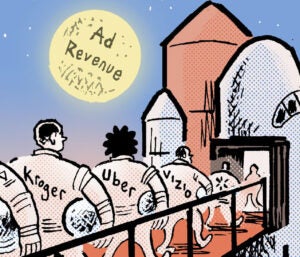
Meanwhile, ChatGPT token costs are skyrocketing, and although ChatGPT Ads recently hit a $1 billion run rate, that still leaves a long way to go if it plans to hit its goal of $100 billion in ad revenue by 2030.
But, as AdExchanger Editor-In-Chief Allison Schiff so bluntly asked Coulter, “Is that real?”
Since OpenAI has filed its S-1 (the first step when a company plans to go public), it “can’t share any feedback like that,” said Coulter, adding, “The PR team will pull me off the stage immediately.”
Call it Schrödinger’s ad revenue: It’s both possible and impossible until its final state is revealed.