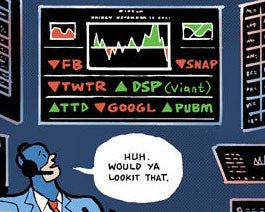

Procter & Gamble has anointed MediaMath as the next demand-side platform in its growing DSP roster.
P&G is also working with The Trade Desk, and with Neustar as its global data management platform.
On Tuesday, MediaMath revealed that it had received a $175 million credit facility led by Goldman Sachs with participation from Santander Bank. MediaMath will use the money to refinance old debt and fund growth goals.
The fresh credit line undoubtedly will come in handy as MediaMath begins to service its new demanding client and pushes forward with its own product innovation road map.
When P&G parted ways with AudienceScience in May after seven years, it planned to embrace a multiplatform programmatic strategy that decentralizes buying responsibilities across multiple DSPs.
It didn’t take long for P&G’s new programmatic vision to have an impact on AudienceScience.
The DSP-cum-DMP, which powered P&G’s in-house trading desk, Hawkeye, was forced to shut up shop last week, less than a month after its largest client walked away from their longtime relationship.
Although AudienceScience’s contract wasn’t supposed to end until June 30, the company confirmed to AdExchanger on June 1 that it had gone into receivership and suspended worldwide operations.

When the news first broke that the CPG giant was taking its programmatic buying business elsewhere and ending its contract with AudienceScience, P&G spokeswoman Tressie Rose explained the move as a way to bring “flexibility” to the organization.
Although Neustar will act as P&G’s “multiregion” DMP, embracing multiple demand-side platforms such as MediaMath and The Trade Desk enables marketing managers in the 50-plus countries where P&G buys programmatically to make their own decisions.
It’s unclear exactly what role MediaMath will play, but it appears that it will be another buying option for P&G marketing folks in local markets who can choose to use either it, The Trade Desk or perhaps other DSPs P&G might decide to bring into the fold.
AudienceScience was hamstrung by P&G’s need to make global tech decisions that applied across all local markets. The bureaucracy slowed down innovation.
But it’s unclear if P&G’s new strategy will actually streamline its programmatic media buying process.
“The notion of trying to manipulate this diverse array of vendors gives the agency something to do, which is great,” a former AudienceScience employee told AdExchanger. “But it’s missing the point of what programmatic is supposed to be about, which is taking away having to make minuscule decisions so you can focus on more core and elemental things, like getting a consistent measurement strategy across global markets and executing in a localized capability.”
P&G did not respond to a request for confirmation in time for publication.
Update: Both P&G and MediaMath confirmed their new relationship on Thursday.