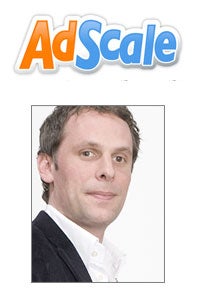
 Matthias Pantke is CEO of AdScale GmbH, an online advertising marketplace based in Germany,
AdExchanger.com: Give us a bit of background on you and how it’s prepared you as well as the evolution of AdScale’s business model – which has been around for a few years, correct?
My career started at DSF in 1997 (the German equivalent of ESPN). In 2000, I joined the KirchGruppe in 2000 where I was responsible for the digital sales channels and the business development of (at that time) new business models like search, performance marketing or rights licensing. In 2005, I joined TradeDoubler, the European market leader for performance and affiliate marketing where I was responsible for the D-A-CH Market.
Today I am CEO of AdScale, Germany’s leading marketplace for online advertisement. Before I joined the company in January of 2008, I had already invested in AdScale at its beginning in April 2007 when the first financing took place. At that time, I consulted with one of the investors, Oliver Samwer, o. a. Founder of Ebay Germany and jamster. Already in 2004, I had noted early US-trading models and marketplaces with the objective of founding AdScale with the current investors. Due to the lack of market size and a missing fragmentation on the demand- and supply-side, we postponed it until April 2007.
From your standpoint, how is online display advertising different in Germany or Europe than in the U.S.? And, any differences in the way exchanges and ad networks are viewed?

The European markets are very similar to the U.S.. We, also, have high fragmentation on the buy and sell side in online display advertising even though a large portion of the 1.2 billion Euro netto market (based on the German OVK Online Report 2010/01) is agency driven (e.g. WPP, Omnicom, Aegis). In Germany we have more than 300 (!) AdNetworks and more than 10.000 display buyers. AdScale is aggregating both parts, transparent and open to all.
The direct advertiser business is still growing fast and search-driven. But, display advertising via marketplaces gets more and more traction in that area as well because of its search analogy on bidding, targeting possibilities and attractive pricings. Over 75 Percent of our current 1.200 campaigns per month run on an average CPC of 50 Eurocent or less, even if the traffic is bought on CPM basis.
AdScale optimization technologies, like our auto CTR algorithms, are very attractive for advertisers. The auction model is also a compelling value proposition for Publishers which makes it easier for them to adjust their supply to the demand of the market. The Yield Management of AdScale is already comparable to big players like Admeld, PubMatic or Rubicon Project.
What momentum have you seen at AdScale in the past year? Any challenges?
AdScale has recorded impressive eight-digit revenue in 2009. We have achieved the break-even point and are profitable one year after the start of the operative business. For 2010, we assume a further increase in sales and, at least, expect a doubling of the existing sales levels. For the German market we expect in the coming year a tripling of the market share of all booked online advertising campaigns via AdExchange from five to 15 percent. As the market leader, we will be able to benefit disproportionately from this increase.
Discuss the transparency you provide advertisers and publishers through your exchange? How does AdScale make revenue?
Our commission is 30 Percent on Publishers revenues. As a marketplace for online advertising the pricing in our system is fair and transparent for both sides. For publishers this means that they can control over AdScale their prices independently and effectively. The price level can always be adjusted according to the efficiency of the advertising space. Therefore, marketers are having the full control over each campaign and at what price it is running. Thus, the average price level in our marketplace reflects the actual price level of the German online advertising market.
How are you making the case for brand advertisers to make use of AdScale’s exchange?
Adscale offers all customers a full transparency on where their ads are running and prohibits all kind of blind traffic. In addition we conduct regular checks to prevent e.g. click fraud and IP locking. The passing through of tags is, of course, also forbidden. The flexible pricing system, especially on secondary premium inventory, is another advantage that is particularly important for brand advertisers.
AdScale is also open for all 3rd party technologies like behavioural- or re-targeting. The live auction system ensures real time bidding and frequenzy capping limits the number of advertising contacts which is especially important for video advertising, which we now have in our portfolio. Last but not least, the reach of AdScale is more than convincing: today as we can achieve more than two-thirds (62.4 Percent, ComScore January 2010) of all German internet users which means that we are second behind Google now after AOL gave up.
Has a secondary channel developed in Europe? In other words, is inventory still thought of as either premium or remnant – or has a new channel been added in between?
Traffic segmentation is the key for publishers because two channels are definitely not enough. Basically, premium networks and direct sales channels are focused on high-priced, often conceptually-driven business in the branding area – as seen in the U.S. market. And marketers who follow neither a technical nor a premium approach and therefore offer no real value will lose their clients.
The collaboration with marketers and networks as a complement to our services is completely possible. Today, we are selling roughly 30 Percent on first and second level AAA publishers, 40 Percent on secondary premium and 30 Percent on longtail, social and user generated content. But the eCPMs differ a lot. From 300 million active impressions we are currently selling 50 Percent of the inventory, the rest is going back to the publisher as a backfill option.
Follow AdExchanger.com (@adexchanger) on Twitter.