 Here’s today’s AdExchanger.com news round-up… Want it by email? Sign-up here.
Google Billings Revealed
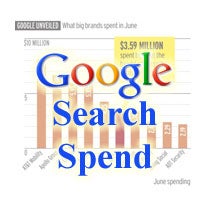
Ad Age’s Michael Learmonth reveals the contents of what he says is an internal Google document which shows recent spending by Google’s largest search advertisers. Learmonth writes, “Our review of $574 million of Google’s U.S. billings over the first half of 2010 shows plenty of global corporations spending millions each month on search advertising, as well as a great many huge corporations that spend very little, if anything, at all on search.” Read the article. A data nugget from the doc: 1,356 advertisers spent between $10,000 and $100,000 per month in the first half of 2010.
Do-Not-Track Is-Not-Simple
The idea of offering consumers the ability to opt-out of digital ad tracking in much the same way as they opt-out (supposedly) of telemarketer phone calls has been getting some attention recently as the privacy debate strengthens. Harlan Yu says on the Freedom to Tinker blog hosted by Princeton’s Center for Information Technology Policy that it’s not as easy setting up such as a service as some may think. Yu says, “The underlying difficulty in designing a simple Do Not Track mechanism is the subjective nature of privacy. What one user considers harmful tracking might be completely reasonable to another. Privacy isn’t a single binary choice but rather a series of individually-considered decisions (…)” Read more.
Display For SMBs
Co-founders Adam Berke and Peter Krivkovich of self-service, display advertising company AdRoll talk shop with Robert Scoble in a Building 43 interview. The AdRoll team announces they’ve doubled their revenue for the last three quarters and are currently growing 35% per month. Krivkovich says that AdRoll has a 95% client retention rate, too. Not bad for top-of-funnel display advertising. It doesn’t hurt that AdRoll appears focused on the low-hanging-fruit of retargeting as well as overlaying what the company describes as intent data. AdRoll also suggests that they’re talking with Intuit about distribution of the AdRoll offering to SMBs. See the interview.

Holding Companies Consolidate
Rupal Parekh of Advertising Age covers ad agency holding company housekeeping trend which Parekh says is currently underway: “Omnicom Group, WPP, Interpublic Group of Cos. and MDC Partners in the past few months have all streamlined the number of individual shops and agency offices sitting under the same umbrella.” Read more. Consolidation is happening everywhere -including the holding companies – but, new, independent companies such as digital-only agencies are popping up, too.
Digital Publishers Booking In Paper
In Australia, media firms are struggling with evolving their business practices according to an article in the Australian. Media Federation of Australia president Henry Tajer said that “it was ironic that many digital publishers still required paper-based ad bookings in a sector already complicated by the continuing fragmentation of media and the arrival of more and more possible media channels.” He’s proposing an automated, digital exchange to help with booking. To be clear, it’s not an ad exchange. Read more.
Big Data
From his personal blog, Greg Linden finds a recent article from Microsoft called, “Server Engineering Insights for Large-Scale Online Services.” Linden is surprised by the amount of detail provided in the paper about the serving clusters used for Hotmail, Cosmos (Microsoft’s MapReduce/Hadoop), and Bing. Read more. And, Download the Microsoft paper (PDF). Any article with the word “petabytes” gets AdExchanger.com’s attention.
Ad Verification Rocks
In a piece on ScribedMedia.org, Peter Cervieri pens “Why The Future of Online Advertising Includes Ad Verification.” Cervieri thinks their is too much investment on everything from the creative audience segmentation to risk buying a media placement without some form of ad placement verification: “How effective is your advertising when it seems like the most inappropriate thing to peddle in relation to the content I’m reading.” Read more.
Tech Slow To Hire
According to Catherine Rampell of The New York Times, the tech sector is slow-to-hire due in-part to continued weakness in the economy as well as certain high tech jobs moving overseas. Rampell writes, “Job growth in fields like computer systems design and Internet publishing has been slow in the last year. Employment in areas like data processing and software publishing has actually fallen. Additionally, computer scientists, systems analysts and computer programmers all had unemployment rates of around 6 percent in the second quarter of this year.” Read more. But, the growing AdExchanger.com job board says otherwise (gratuitous plug!).
Fantasy Online Marketing
Brent Halliburton writes an entertaining post on his Cogmap that compares the wildly-popular world of fantasy football to online marketing. He begins, “Most people doing fantasy drafts simply make a list of who they think the best players in the league are and bang, bang, bang, draft Let’s call that ‘Old school media planning strategy’. Or let’s call it ‘People who evaluate campaigns based on CTR’. Or ‘people who don’t love math’. Or ‘people who suck!” Or ‘me’, most years.” Read more.