

Programmatic will be key to Spotify’s ability to scale as it expands from a music platform to an audio platform with spoken-word content.
Since launching its audio capability in 2016, Spotify’s programmatic business has grown to capture 20% of all ad revenue on its platform. In addition to a self-serve platform launched in 2017 that caters to direct response buyers, Spotify offers private marketplaces (PMPs) and programmatic guaranteed deals for brand advertisers, as well as direct IOs.
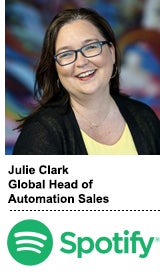
As streaming audio becomes a more popular buy among advertisers, Spotify wants to be able to transact any way a brand wants, said Julie Clark, global head of automation sales at Spotify. That’s why its entire sales team is trained to sell both programmatic and direct inventory.
“In the year and a half I’ve been here, I’ve seen audio go from being an interesting conversation to something marketers really need to understand,” she said. “The market is moving toward more automation, but different clients have different needs.”
With its acquisitions of Gimlet and Anchor making it a major podcast player, Spotify wants to apply the same automation to its spoken-word inventory. But it’s still early days, Clark said.
“It’s a unique listener experience,” she said. “It will likely be true to how Spotify approaches everything: starting with the user experience.”
She spoke with AdExchanger.

AdExchanger: How has demand for programmatic audio changed over the past year?
JULIE CLARK: We’re seeing programmatic guaranteed grow at an extremely fast clip. That’s from the technology becoming better but also clients wanting that fixed rate with audience guarantees attached.
But marketers have different needs and we look at it holistically. Is a PMP going to be the best solution for this? Maybe. Is it programmatic guaranteed? Great, we have that too. There might be campaigns where it’s partially a direct IO or a supplemental PMP.
How has your self-serve platform grown since you launched in 2017?
Extremely fast. This is satisfying an area of the market that wants to stand up an audio campaign within minutes, like concert promotion. It puts Spotify in the hands of every brand. It’s a way we can expand our footprint and work with local brands.
And we’re adding more features. For a certain subset of clients we’re leveraging the ability to upload audiences. We’re revising how we forecast impressions delivered in a campaign. There’s deeper first party-data that’s going to become available as well.
How does Spotify leverage first-party data in ways that set it apart from competitors?
It’s different than other data in the marketplace because it’s tied to cultural events. We see streaming behavior change based on what’s going on in different countries. But how do we tie that in a smart way to brand outcomes?
It might be at the segment level, or looking at music intelligence to understand how [people] engage with different playlists. We just launched a new product in Discover Weekly, [a playlist] powered by machine learning based on your listening behavior. Now we’re incorporating an ad experience within that to be able to connect brands more closely to listeners.
How are measurement and attribution evolving on Spotify? What metrics are brands looking for and what are you able to provide?
In the programmatic space, it tends to be viewability and brand lift. We work really closely with clients to understand what they are measuring on the back end to make sure they’re getting the device IDs and data they need.
Brand outcomes are going to be key. How are we tying this audio experience to moving the needle for brands? That engagement over time is going to change. We’re going to have more opportunity with smart speakers. What does it look like when people start to interact with ads? That’s an exciting opportunity to get more finite intent metrics.
How much education do you have to do for buying programmatic audio?
We’re ingraining automation and programmatic into the sales culture. It is part of the DNA now. Every single salesperson globally is empowered to have those conversations with clients.
The marketplace is still evolving. Traditional radio buyers have been really quick to get more sophisticated with targeting and leverage automation. From a programmatic perspective, people are used to buying display and video, so audio is still new. It’s growing very quickly but it’s still a question of how to incorporate it and why?
Where does programmatic fit into Spotify’s podcast strategy?
It’s early days. It’s an exciting time to explore what the ad experience overall is going to look like. Everything is on the table right now. Host-reads work. We’re also working [with] brands to create their own podcasts and the ads within that.
I believe at some point in time we’re going to have different ad formats in podcasts. As to what that sounds like, I don’t know right now. The research we’ve been doing shows consumers are really receptive to advertising within podcasts. So, there’s certainly something to that.
This interview has been edited and condensed.






