Today’s mega-retailers sit in a unique position that will prove a critical element to media online and off. They have a store at the corner. Many corners.
And that’s because – news flash – humans aren’t going all-digital with an I.V. into a data warehouse. Though we may spend endless hours in our Facebook world (or whatever comes next), we’ll still drive to the local Starbucks for a cup, buy trinkets at Target or pick up some plywood from the local Home Depot, and so on.
The thing that changes “offline” in the future will be the ability to leverage digital’s insights and lead these retailers to – wait for it – its media company future. These initial steps were taken long ago as “Soaps” were sponsored by consumer packaged goods companies – and this was when data and intent weren’t nearly as well-understood. The world only gets more predictive from here as at-scale players in retail get to see all the buying trends using first-party, digital data that is collected online and off. Powerful, data-driven mojo.
A key part of the retailer strategy is the ecommerce store, of course, and its interplay with the offline presence. Not only does the online store drive sales but it collects and learns from valuable data that only the mega-retailer owns, and then maps that data to consumers who are buying offline. The retailer CMO will steadily be able to close the gap of inefficiency bringing online and offline sales data to inform media spend – and in real-time. It’s the “attribution” or “media mix modeling” Holy Grail. And the retailer stands at the crossroads. Literally.

Not to be left out in the cold will be a long tail software company or two that brings the same types of attribution capabilities to smaller retailers. Sound familiar? -but these software companies could be the mega-retailers who white-label their systems for even more revenue and insights.
Looking over at CPG companies, CPG-ers could appear to have less chance for data capture in online – merchandise companies don’t get to drop cookies and understand their customer’s interests, for example, like the ecommerce store retailer. Here’s where brand will be as huge and powerful as ever and create leverage for data deals.
A few thoughts on how the online/offline attribution machine could play out for the retailer:
Scenario #1 – Retailer Promotion
A retailer such as Target can instantly scan its store shelves with the help of RFID or some other acronym and understand that store items aren’t moving and its time to make a decision: “Can I spend more media to sell those products for profit or does it make better sense not to use media and send it back to the manufacturer who has to eat it?” Retailers can do this a bit today.. but not in real-time and in a way that merges online and offline media with sales data – a “Big Data” stew. The retailer needs a software tool to help make real-time media decisions. Once they do, media is their playground.
Scenario #2 – Partner Promotion
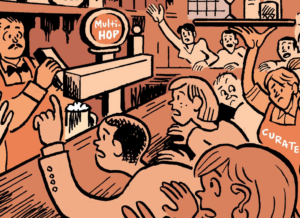
The mega-retailer owns the data for in-store, let alone online. If they can create buying algorithms that leverage proprietary, retailer sales data and then make it available to manufacturing partners who have their pockets full of trade/co-op dollars, well, let the sun shine in – let the manufacturer pay for promotion of its products. All the retailer does is play curator to its in-store content and, most importantly, its brand. The retailer could also supply its own branded, AdWords-like product that could either hook into media supply or let the partner hook into its own media supply and just use the retailers “media buying API.”
Retailers will have a much more robust software component tomorrow as the buying and selling of media could come through them, like it or not.
Scenario #3 – Creating Content
Given that the mega-retailers will have a new and better way of buying media, this should drive profits for them and their partners. Over the long haul, the “retailer as media company” opportunity appears where cash flow will be used for compelling content which reaches target audiences. Effectively, we’re back to the “Soaps” and the evolution of branded entertainment.
So, that’s three legs of a stool that creates a constant dialogue with the consumer: online store, offline store and media to spur the interest and drive the intent. And it’s all owned by the retailer and the data-driven, retailer CMO who takes control on her company’s top and bottom line revenues – and, more control in the C-suite.
By John Ebbert