 Recent reports from research firms IDC and Gartner suggesting that PC shipments are on a downward spiral confirmed what marketing software vendors already know: we are living in a post-PC world in which consumers move between various channels.
According to IDC, worldwide PC shipments totaled 76.3 million units in the first quarter of 2013, down 13.9%, making it the largest single-quarter slip since IDC began tracking the PC market in 1994.
Gartner released similar data on the same day, showing global PC shipments totaled 79.2 million units in Q1 this year, an 11.2% decline from last year’s first quarter. It was also the first time shipments dropped below 80 million units since the second quarter of 2009, according to the research firm.
Meanwhile, mobile advertising spend continues to grow. US mobile advertising spending rose 178% last year to $4.11 billion, according to a recent forecast by eMarketer. The firm predicts mobile ad spend will reach $7.3 billion this year, and US advertisers are expected to devote $27.13 billion to mobile by 2017 – nearly 45% of all digital ad spending and 13.8% of total media ad spending for that year.

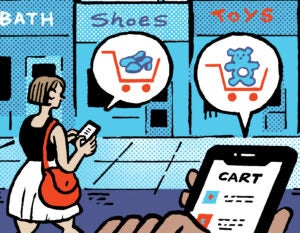
“It might be tempting for marketers to say, ‘Mobile is growing so fast, let’s focus on that,’ but their customers are likely on all kinds of devices, so it doesn’t make sense to think in silos,” Alfieri said. “From Turn’s perspective, that means we have to make sure that in addition to building out our capabilities for mobile…we provide a cross-channel dashboard that shows the interaction between all of the channels.”
Even though PC sales are dropping, ignoring them would be a great mistake, agreed Jeff Green, founder and CEO of The Trade Desk, an RTB platform.
“We absolutely consider mobile the promise of the future…but the here and now is about reaching your audience at scale, which is still on the larger screen — laptops and desktops,” Green noted.
And despite its growth in recent years, the mobile ad ecosystem is “still pretty nascent,” Green added. “There are a bunch of problems to solve, such as user targeting, before it gets its eventual share of the media plan.”
Although mobile ad platforms and other mobile-first vendors have cropped up, they will not likely be able to cut any corners developing a mobile ad market, according to Green. “Seemingly the ecosystem has said, ‘Let’s just skip to the end state’ — with exchanges and RTB and such,” he commented. “But I’m not sure there is any way around the pain of establishing healthy markets.”