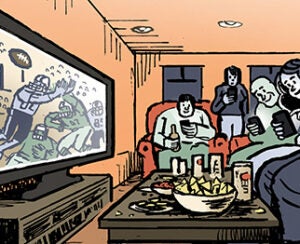
 This morning NBC Universal entered a strategic partnership with Comcast and Twitter to engineer a “See It” feature allowing Xfinity TV viewers to take action around a TV show from their Twitter stream. The integration allows Xfinity TV viewers to take actions such as starting a show on-demand or setting a DVR to record.
Executives from both companies spoke on a panel today at GroupM’s “What’s Next” client event in New York City.
“We don’t have all the answers,” Fred Graver, head of TV at Twitter, said of the company’s pole position in the “second screen” viewing trend. “But we are working closely with brands, advertisers and television networks and [bringing in the right] talent” to tackle it.
“We didn’t design Twitter as a second screen, the audience chose it.”
In addition to the See It feature, NBCUniversal and Twitter have forged an advertising agreement today to give NBC’s portfolio – two broadcast networks, 17 cable networks and 50-plus digital properties – broader access to Twitter audiences and platforms through short-form content embedding through the social platform. Ad placements will “ride along” with videos on Twitter.
NBC Sports Group was the first to test it by embedding short-form sports videos for fans. USA Networks will test a second-screen campaign using the service for Modern Family beginning Oct. 18. The NBC advertising partnership follows Twitter’s announcement of a similar alliance with CBS, that came just weeks ago.

“Just during prime time alone, we saw 39 million tweets during this year’s Emmys,” Graver said, which marked a 48% increase in volume year-over-year. “That gets even more important when you begin to look at reach. We hear all the time from producers that if they want to see how a show is doing, they open up Twitter as they’re watching. Twitter is live, public and conversational. There is no gap between creation and consumption of content.”
NBC, according to Michael Bologna, managing partner and director of emerging communications at GroupM, has the ability to address the second-screen phenomenon and to deliver a cross-channel, cross-device set of metrics that comes down to data, infrastructure and content. “NBC has the beauty of content connected to a distributor to push data and return that data on households that’s very powerful.”
According to a new report from IPG Media Lab and MAGNA GLOBAL, “The Second-Screen Fallacy,” 2.8 million TV-related tweets are sent per day in 2013. Sixty percent of consumers tune in to a “secondary device” like a tablet or a smartphone during TV ad breaks.
Edward Swindler, president of strategy and operations for NBC Broadcasting, touched on these behaviors and their impacts on the broadcast network. He cited an “atomization” of the television audience that has made it tougher to monetize.
“NBCUniversal spends $9 billion on TV content every year,” he said. “It’s becoming increasingly hard to pay for than it used to be. This is an issue we have to deal with. Advertising is half of how we pay for programming. If we can’t figure out how to create [and deliver] content effectively, you [the advertiser] have a problem.”
Swindler said the digital consumption seen in the most recent summer Olympic games is evidence of the fact, but that there is some data suggesting the positive proof of the effect. While television still accounted for 89% of viewership, 11% of people consumed the content digitally. Fifty percent of NBCOlympics.com users engaged with social media during the games, as well.
Swindler also alluded to a growing “TV Anywhere” approach and strategy the broadcaster is embarking on, with plans to release digital ad insertions across all on-demand content in the coming quarter.