As advertisers increasingly turn to audience buying, social media, and other methods of aligning with content that allows them to bypass traditional publishers directly, those outlets need to find ways to maintain their relationship to readers and ad dollars. Last week, The New York Times Company unveiled new tools that support its online content by leveraging the various channels it travels on.
The plan for the main tool, dubbed Ricochet, is to ultimately transform it into a self-serve contextual ad tool that lets marketers pick specific content from the NYTimes.com, Boston Globe’s sites and About.com and attach an ad to it outside those NYTCo domains. For example, if a company finds a NYTimes.com piece and places it on its official blog, on its Facebook page or tweets about it, it can place an ad on that linked item, even if another marketer has an ad on the original NYT website page.
Ricochet is being joined by a social media monitoring product called Cascade, a visualization tool that lets an advertiser see how an article was shared across a specific period of time. It’s meant to appeal to advertisers who want to identify “key influencers” across Twitter and either reach out directly to them or at least help them better understand how content that’s relevant to their business and audience is being shared and discussed. (Read the release.)
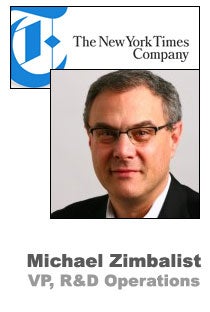
“This product is completely between advertiser and publisher,” said Michael Zimbalist, the NYTCo’s VP, research & development operations, in an interview with AdExchanger. “The advertiser and the publisher make a deal to have that marketer’s brand message around the article for the media channels owned by the marketer – such as their official blog or their Facebook page. And in those channels, there’s no intermediaries.”

Cutting out the middleman doesn’t meant cutting out the NYTCo’s sales teams, Zimbalist is quick to note, adding that the R&D group’s New Ventures team, which is running Ricochet and Cascade, will be working with ad sales at the NYT, Boston Globe, and About to ensure that that traditional side doesn’t get cut out of the loop entirely. “We view Ricochet and Cascade as an entirely new revenue stream that’s incremental to what we already do,” Zimbalist said.
For the moment, the program is still in the “pilot” phase with business management software solution provider SAP, along with a few other marketers Zimbalist declined to identify. The business model is based on a fixed price for a set duration. Essentially, the brand has the opportunity to generate as big an audience for the article – and in turn, their advertising or promotional message – as they possibly can. In addition to the fees from the service, the NYTCo also gets marketers to help distribute its content to a targeted audience.
The concept of Ricochet germinated out of Cascade. The R&D team was considering how NYTCo content was being shared through Twitter and other social media outlets. “We noticed that a lot of brands, small businesses, well-known professionals in a given area, share our stories. The thought was ‘How can we build a product that would offer those individuals and entities greater value for the sharing activity they’re already doing?’
“So when a brand uses Ricochet, they get a variety of reporting data,” Zimbalist continued. “They get standard ad metrics for the pages that their ad impressions are attached to and they also get Cascade, a social media monitoring tool that lets them see when the content that they’ve Ricocheted have been shared and by whom.”
We spoke to a number of media buyers and analysts and the surprising notion that a traditional media company would look beyond trying to keep its content and advertising within its domain walls – especially considering the online pay models put in place by at the NYT and Boston Globe – represents an intriguing prospect.
“The reason I think that it’s great is that while marketers are increasingly getting into the content business, the problem is that they generally aren’t able to generate great content,” said Rishad Tobaccowala, chief strategy and innovation officer of VivaKi. “What Ricochet does is, within the right topic areas, is allow them to realign their marketing with great content simultaneously – all without adding any incremental cost to the NYT. It also recognizes the church/state divide between advertising and editorial in a different way. Finally, I think it’s a win for consumers, because they get the right message with an appropriate ad, while it’s still clear that the ad and editorial are separate, making it a triple win for all sides.”
Gary Reisman, co-founder, NewMediaMetrics, a brand strategy analytics firm in New York, sketched out a scenario for how Ricochet can improve upon existing contextual advertising plays: “Typically a marketer would buy the tech section of the NY Times. These services just allow marketers to tie themselves to content. A brand should be able to buy the media that’s most contextually relevant to the customers of the brand. It’s getting one step closer to contextual relevance and away from demographics. It’s interest-based marketing. It’s a step in the right direction. But the marketer is still making decision for the consumer about what is contextually relevant. It would be better to align contextual relevance and the ad buy in a more efficient way. I don’t know that I would use this service if I were a brand guy. I don’t see it as changing the world.”
Ultimately, this is not about marketers finding that it simply isn’t easy to create and aggregate news that consumers are actually interested in. As Brenda Fiala, VP of Strategy for Blast Radius, notes, “Marketers are not publishers alone. They are entering into a two-way relationship between their brand and their consumers (and potential consumers). By connecting topics that are meaningful together, the conversation is furthered and amplified. Alternatively, if not done in a manner that is relevant to consumers, it can come across as inauthentic. The risk is more visual graffiti in the digital space that consumers need to wade through in order to get to what they most want to read. If done well, the benefits are powerful for both consumers and brands. Consumers can be directed to information and people they may be surprised and delighted by finding. Brands can measure the engagement with the material and see the organic (as well as amplified by paid influencers) via the visual display of connections.”
We also reached out to WPP Group’s Mindshare, which is the NYTCo’s launch partner for Ricochet and Cascade, and asked why they decided to get involved. Dervilla Kelly, Worldwide Managing Director, Client Leadership at Mindshare, said in an email, “This platform supports our overall campaign promise: Run like never before. It enables SAP customers to do just that by delivering the content most relevant to them via social media.”
By David Kaplan