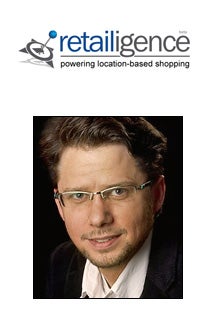
 Jeremy Geiger is CEO of Retailigence, a location-based shopping technology company.
AdExchanger.com: Do you think 2011 is the year that mobile finally lives up to its billing?
JG: We believe that 2011 will be the year that mobile in the US will finally catch-up with the rest of the world.
What problem is Retailigence solving?
Retailigence bridges the gap between a consumer finding or discovering a product in nearly any medium, and then allowing them to easily take that next step to actually purchase the product at a nearby store. Research shows that as much as 87% of consumers research purchases online before they buy offline (source: BIGresearch’s June Consumer Intentions and Actions Survey), but before Retailigence came along, actually finding the product in-store frequently required consumers to do a lot of hit and miss legwork, and many sales were lost in the process. Retailigence streamlines the path between product discovery and in-store purchase.

Retailigence appears to have four target client markets: publishers, brands, developers and retailers. Can you drill down on each of these silos to reveal what some of these target customers might look like?
Sure, publishers can make advertising or editorial content more effective by adding a “find it near me” feature to any products featured within their content. Target customers would include online publishers, traditional magazines and newspapers, blogs or petty much any content creators where products are featured, location can be determined and where consumers can take action to find it nearby. We would love to work with an IPTV provider to see how we could work with them to push the envelope.
Retailigence is also great for keeping brands connected to their most loyal customers. Brands spend millions of dollars every year to reinforce their messages and to build brand and product loyalty. But at the end of the day branded products also need to be easy to find and buy. Retailigence creates a brightly lit runway to guide consumers directly to their desired destination… your brand at the nearest and most convenient store possible. Target customers would be most any brand owner, but there is a particularly good fit with products that can sometimes be hard to find, or where there are many competitive alternative for customers to switch to, out of sheer convenience of availability. It’s also great for products that consumers want to touch, try-on, or speak with someone about, before purchasing.
The Retailigence solution is ideally suited to mobile application developers, because more and more phones are becoming location aware every day, and consumers are beginning to use their phones for anything and everything including shopping. The most obvious benefit for mobile developers would be to expand the capability of their existing services to give consumers a choice between and an e-commerce option and a ‘find the nearest store’ option. Other target customers would include nearly any location-based services (like FourSquare, Gowalla, BrightKite, etc.), shopping applications and tools (including any application with bar-code scanning functionality), virtual assistants and mapping solutions.
Finally, there are really two opportunities to leverage Retailigence if you’re a retailer. For one, many of these organizations are growing more large and complex and multi-channeled everyday, and simply having access to centralized, unified and open inventory availability across retail, telesales, catalog and e-commerce groups can be a powerful benefit… just ask Nordstrom’s which recently saw an 8% lift largely thanks to a program designed to open up access to its internal inventory systems. Second is the reality that consumers are increasingly using digital tools to discover and shop for items, yet very often still want to buy in store, and increasingly a retailers’ stores and the products they sell need to be easily found in the “here and now” or they will increasingly risk losing the sale. Target customers include both small and large retailers who have some electronic records about the products they sell.
How do you address pricing and/or revenue sharing with your client partners?
Our bread and butter is pay per use metered through the use of our APIs. But we believe that our service adds significant value, and are willing to demonstrate this by offering pay for performance when and where it makes sense.
You’ve taken an initial small round of $1.5 million. Will you need more eventually? Does a company with a business model like Retailigence’s require less capital?
Retailigence has had an overwhelming response from the investor community and is well-positioned for further funding.
Could Retailigence bridge beyond mobile search and into video or display?
We think that the potential applications for the Retailigence service are enormous. For example, in this age of rapid innovation in the digital advertising world, it’s not difficult to foresee a world where a generic banner or video ad is made more relevant by featuring a locally available product, including price, color and how to get to the store.
Is your product in-market today? What’s the roll-out plan?
Yes it is in-market today and we are rolling-out rapidly to additional verticals and solutions with the greatest consumer demand.
Why do you think you won the Best in Show award at the recent 2010 Under the Radar Conference?
It’s simple. We solve a real and complex problem and we do so with a solution that is quite simple to integrate. Yet if you stop to think about it, what we can provide can really be quite powerful in the breadth of areas where the information can be applied… from mobile shopping and digital ad serving to providing mass localization for national magazines, broadcast or product sampling efforts.
A year from now, what milestones would you like Retailigence to have accomplished?
Retailigence will become like air for the consumer goods market. Consumers will no longer be satisfied with simply knowing that a product is for sale somewhere, but will demand details about exactly what variations are available when and where. It will be a necessity, available anywhere you go, through any application you use, to keep you sane and happy! ; )
Follow Retailigence (@retailigence) and AdExchanger.com (@adexchanger) on Twitter.