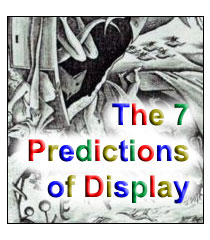
 As if turning the work of Pieter Bruegel the Elder on its head, Google vp Neal Mohan and managing director Barry Salzman presented a decidedly cheery picture with seven predictions for the 2015 display market in a keynote presentation at yesterday’s IAB MIXX event.
And the predictions are:
- Video ads on a CPV: (from the Official Google blog) “50 percent of ad campaigns will include video ads bought on a cost-per-view basis. That’s up from very little today…”
- RTB and audience buying – a match made in heaven: “…advertisers are starting to deliver ads that are tailored to particular audiences. Many are using real-time bidding technology, so that they can bid on the ad space that they think is most valuable. In 2015, 50 percent of these ads will be bought using this real-time technology.”
- Mobile is coming, no, this time it really is. “…mobile is going be the number one screen through which users engage with advertisers’ digital brands.”
- “Clicks” will be an ad stat anachronism: “Today, the ‘click’ is the most important way that advertisers measure their display ad campaigns (…) With new measurement technologies emerging, in five years, there will be five metrics that advertisers commonly regard as more important than the click.”
- The news world will be wrapped with social and so will the ads: “…in 2015, 75 percent of ads on the web will be “social” in nature—across dozens of formats, sites and social communities.”
- More rich media coming to the display auction: “Rich media formats work. (…) today they only represent about 6 percent of total display ad impressions. That will increase to 50 percent, for brand-building ad campaigns.”
- Publishers are going to make more money: “All the investments that are making display advertising smarter and sexier will help publishers increase their revenues. Display advertising is going to grow to a $50 billion industry in five years.”
That last prediction remains to be seen as some large publishers may not be able to sustain direct sales (and thus maintain or grow revenues) for differentiated content even if it’s surrounded by a decent brand due to audience that can be found elsewhere, and for cheaper, through RTB’d auctions.
To read more about Google’s presentation, visit the Google blog. And, more coverage from ClickZ and The WSJ.
With DoubleClick Ad Exchange pumping, Google is full-steam ahead on display – anybody not seeing this? J-U-G-G-E-R-N-A-U-T. Toot! Toot!
By John Ebbert