“The Sell Sider” is a column written for the sell side of the digital media community.
Today’s column is written by Rotem Shaul, CEO at Primis.
Programmatic advertising has grown by hundreds of percentage points, and as the industry has matured, market consolidation has commenced.
Many vendors are too small and cannot compete with the industry’s maturing tech and with big players’ data. Others are in an M&A frenzy to get better technology, sales efficiency or data to better position themselves in the market.
From January 2016 to April 2018, advertisers reduced the number of demand-side platforms (DSPs) to 4.2 from 6.9, a 40% decline, according to eMarketer.
For some, the trend might seem natural, but there is a big downside for the whole programmatic industry and DSPs: M&As are self-annihilating the programmatic industry.

There are thousands of brands competing in online ad auctions, but somehow, over time, supply-side platforms (SSPs) get fewer and fewer competing bids . This is not because there are fewer buyers that want the inventory – it’s mostly because the number of DSPs has decreased over time.
The real value of each impression is not being valued according to the real supply and demand out there. It is heavily affected by the number of DSPs that represent the demand.
The auction
In order to demonstrate this, we need to better understand the Vickrey Auction, also known as second-price auction, where the highest bidder pays the second-highest bid.

In a perfect world, the brands would compete against each other, and brand A would win the impression and pay $8. However, in a consolidated world, the scenario increasingly looks like this:
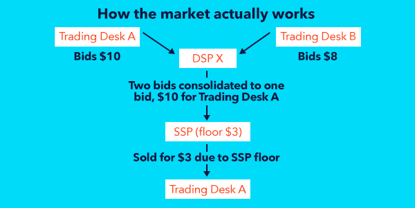
The impression sold for $3, because the SSP set a floor. If the publisher used a $9 floor, it would have tripled its income. Setting floors on a whim is not a recipe for an efficient market.
The waste is huge. SSPs and publishers build teams and technologies trying to predict the best floors to use, attempting to find the sweet spot to simultaneously optimize fill rates and CPMs.
With hundreds of thousands of domains selling billions of impressions to tens of thousands of buyers, one would expect that the market would support itself by engineering an auction that helps determine the true value of each impression, without people manually setting floors and investing in prediction algorithms to find the right floors.
First-price auction?
In a first-price auction, buyers know that if everyone bids the highest bid on a desirable impression, it might work out well for that one impression, but in the long term all buyers will lose. Buyers will have to try to adjust their bids and behavior to the market and not always bid the most they can.
So with first-price auctions, buyers will spend as much effort trying to determine how much they want to bid as sellers trying to identify the optimal price floors. We are not solving the problem – we’re just passing it on to someone else.
Solving the problem
One easy engineering solution that would dramatically increase competition is to break down the bid activity of DSPs to trading desks so that each trading desk will get a different seat ID and bid separately, even while using the same technology provider. An SSP can send DSPs bid requests per each instance and get different bids:
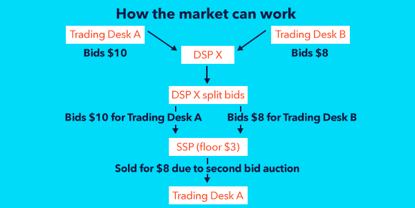
As shown above, if the DSPs created different seat IDs for each trading desk, the market would get a better view of the true demand and supply. There is no reason why all trading desks should compete under the same bid as they do now.
The setup should also be quite simple – no need to change bidding algorithms or integrations.
The fact that people are optimizing floors manually and companies are building tech to predict the best floors per geo, device, etc., should be a wakeup call for everyone. The open market is not doing its job; consolidation is here to stay and we need to change the bidding mechanism so the market will function properly. Shifting the problem from the seller to the buyer doesn’t solve anything.
We need to work together and find a better solution that will automatically determine a fair value for each impression in a way that represents the true demand and supply, as seen by trading desks, brands and publishers.
Follow Primis (@PrimisLtd) and AdExchanger (@adexchanger) on Twitter.