
 “AdExchanger Politics” is a weekly column tracking developments in the 2016 political campaign cycle.
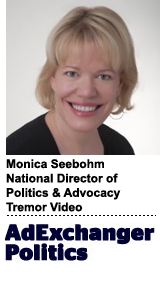
Today’s column is written by Monica Seebohm, national director of politics and advocacy at Tremor Video.
At the Campaign Tech East conference two weeks ago, much of the conversation focused on whether or not the 30-second TV ad still works for politics.
When content is being consumed in smaller amounts and mobile devices are increasingly the primary source for information, communication and video entertainment, do we risk campaign ad fatigue if we just repurpose those 30-second spots online.
Campaign managers understand that TV can’t be a solo act anymore. Voters are consuming video, including TV content, across all devices throughout the day. Because online video lets political marketers take what they love about TV and combine it with the power of digital, this is the first cycle where creative is being developed specifically for digital channels.

Ultimately, when developing best-in-class video creative for political campaigns, it comes down to knowing their audience, channel and goal.
With digital, political marketers can create a template that works to deliver their overall message, and swap out snackable elements for each audience they want to reach. For example, one could develop a template that uses the same voiceover, but the messages are personalized for each target market with different images within the ad.
Similarly, politicians can engage real people to discuss local issues that impact them the most. They can cut the content for different 15- and 30-second video spots and deliver them to target audiences that are deemed most responsive to the message and “sender.” In this case, digital video can be used to capture the often elusive one-to-one, authentic voter conversation.
Other questions political marketers must grapple with: Are video assets being specifically created to run alongside content? Will they run on mobile devices, desktops, connected TV or will they live on social media? Should the ads be 30 seconds long or can the message be communicated in just 15 seconds?
If the video is going to live in a social media environment, political marketers need to remember that videos playing in a news feed are automatically muted. Getting a voter to opt in to hear the message is the first step. Text may be a good way to entice them with the message, but the use of compelling images can achieve this as well. Videos for social media should look authentic to the platform.
A video on social media that is timely but somewhat underproduced is likely going to be better received than video that looks like it was created weeks ago in a studio. With Memorial Day right around the corner, a Vine or Snapchat video of a candidate teaching children the Pledge of Allegiance or “The Star Spangled Banner” could easily go viral if done correctly.
Lastly, it’s crucial for political marketers to understand their goal before diving into the creative process. Do they want to drive voters to a website or a polling location? Persuade them to watch the entire video?
These things matter and should influence the creative process. For example, if the goal is time spent with the candidate’s message, they should consider including an interactive slate that allows voters to watch multiple videos in addition to the ad.
As with advertising in any industry, maximizing emotion is key. Digital video needs to serve as a complement to TV, not a replacement. As voters continue to consume video at increasing rates, the only way to reach them in a meaningful way will be to consider and create for all screens. Video doesn’t have to be hard or expensive – it just has to be done well.
Follow Tremor Video (@TremorVideo) and AdExchanger (@adexchanger) on Twitter.







