 AdExchanger.com recently asked several members of the advertising ecosystem about “Middlemen” and, specifically:
- “Are there too many parties trying to insert themselves into the online advertising value chain? How do you see this playing out?”
The following contribution is from Jerry Neumann, an angel investor in The Trade Desk, 33Across, Domdex, CPM Advisors and Flurry and a co-founder of Root Markets, a quantitative marketing pioneer.
Once there was only one intermediary: the black box, the ad networks, AdSense. They operated on a model that I’m personally familar with from raising children: you get what you get and you don’t get upset. Then the producers and users of ad inventory decided to grow up and take control of their own process -deconstruct the black boxes and start to learn themselves what works and why.
A network of intermediaries sprang up -densely interconnected but none irreplaceable (but still each their own little black box.). With this network, marketers and publishers can access and control data and learn by monitoring the seams between the various companies. They can also swap out any given intermediary for another if they think they will get better results. This evolutionary process, while painful, is leading us to not just better advertising, but better marketing. And the more atomic the process–the more intermediaries there are–the better our ability to experiment and discover.
But, then the issue becomes not how many intermediaries there are, but how much of the spend they are consuming. Several commentators, Jonathan Mendez particularly well, have noted that publishers get only about 20% of the marketer spend. For marketers, a better way to say this is that up to 80% of their interactive budget is spent on transaction fees. This is way too high: it should be less than 40%. In this sense, there are too many intermediaries, each intent on taking a large enough chunk out of the media spend that they might someday be worth what they promised their investors. The marketers are torn between wanting more granularity and wanting less transactional overhead.
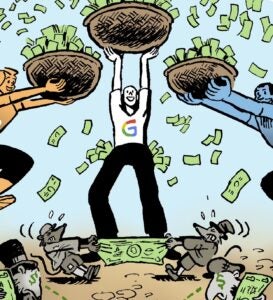
The publishers think they want fewer intermediaries, but absent higher demand for inventory, having fewer intermediaries will not raise publisher CPMs. The opposite is true. If you don’t believe me, plug AdSense back in and see what the single intermediary–Google–nets you. Publishers right now are price takers. There are two ways they can increase CPMs: make the marketers dumber by forcing them to forgo the quantitative marketing tools they have adopted, or make themselves smarter by adopting some quantitative marketing tools themselves. The smart ones are working on the latter. This means more intermediaries, not fewer.
In the next few years, the tension between having many intermediaries–allowing control of and learning from the process–and having few intermediaries-reducing transaction costs–will be resolved by there being three direct intermediaries at most: buyer’s agent, seller’s agent and marketplace (supported by various technology and data providers, who will not themselves be intermediaries.) To get there, each intermediary must become completely transparent to its clients. No more black boxes. Buyer’s agents and seller’s agents must move away from being arbitrageurs and return to the traditional professional services function of trusted adviser.