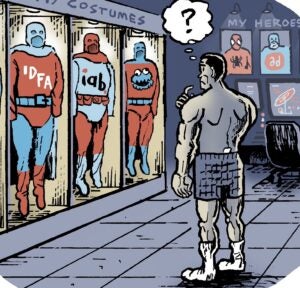
 “Native advertising” is a projection of publisher desires to revamp traditional print advertorials. Advertisers, too, like the idea of doing something unique that dovetails with editorial content and looks good across devices without requiring three creative versions. But scalability remains an issue.
Ad-tech provider Appssavvy is one of several players looking for ways to combine the trend toward native ads with the scale, targeting and efficiency demanded by media buyers.
New York-based Appssavvy’s automated tools — though you can’t call them “programmatic” — rely on things like gaming, quizzes and polls. It calls these “native” because they appear in the user stream. It calls them scalable because they contain content that can be updated quickly. The company is moving beyond games to more traditional publishing outlets, with its eyes on a goal, according to CEO Chris Cunningham, to achieve profitability in about three months.

Timing Is Everything
Appssavvy’s technology uses timing to help determine the sponsored content served in a native ad placement
One direct-response campaign for Coca-Cola, called “Giving Happiness,” targeted teens. The message and call to action were centered on “sharing.” When a site’s user shared the ad on Facebook or Twitter, a contextual frame was triggered with a creative spot that spoke about “giving” and asked them to “share” again.
Another direct-response campaign, for cable channel TNT, targeted users with high scores. When a scoring threshold was crossed, a trigger was set in the form of an “acknowledgement” of the user’s achievement. Attached was an ad that said something like “Nice Shooting” with a screen that faded away.
By timing it to those “natural breaks,” Appssavvy promises its ads are more effective.
“Our view, which is aligned with Twitter, Tumblr, Foursquare and Pinterest,” Cunningham said, “is that consumer behavior has shifted from reading and looking at passive content to actively using content that aimed at getting something done, whether it’s satisfying a search question or sharing something you care about with others,.
“As this behavior has shifted, so should the ways ads are triggered.”
Appssavvy began employing the IAB Rising Stars in-stream ad units for both Web and mobile this past spring, in order to ensure that it can better join its native ad model to standardized display formats.
In particular, Appssavvy is delivering a Full Page Flex mobile “Rising Star” ad unit, which features a screen takeover and dynamic insertion. The use is meant to reflect Cunningham’s view that that Web ads not only need to reflect the publishers’ sites they appear on, but also take into account what a site’s users are actually doing there. The ads appear during what Cunningham described as a “natural break within the user flow,” such as when someone has shared content or has reached the bottom of an article. Someone might be more receptive to one message while sitting at their desk at 2 p.m. versus sitting on their couch at 10 p.m., the timing model guesses.
Depending on the goals of a campaign, Appssavvy targets audience segments based on who looks like they’ll be most receptive to the message for either brand awareness or direct response. The publishers in its network can plug in the ads on their site as they see fit.
But Does It Work?
“It’s a compelling proposition,” said Adam Shlachter, SVP for media at Digitas, when asked about Publicis’ interactive shop’s recent work with Appssavvy, particularly in making the ads more “real-time.”
“The challenge they’re able to solve is to deliver native opportunities at scale — opportunities driven by consumer behavior — and the way Appssavvy targets is largely what answers the scale question,” Shlachter said. “If you target based on behavior and activity, it’s not fixed to any one act or placement. That offers greater scale. It exists across their platform, which is tied to different social environments and a broader audience across gaming [and] social. We’re still experimenting to see which environments work best, trying to figure out what are the triggers for better performance.”