

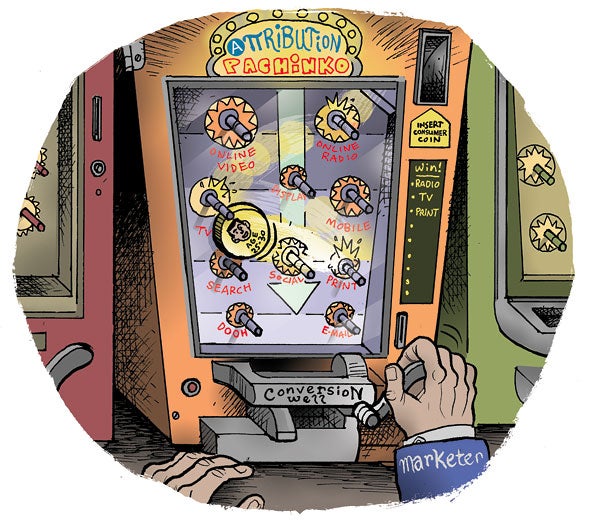
Multitouch attribution has fallen into disrepair. Facebook and Google platform attribution is a mess. User-level tracking is going the way of cigarette smoking during a pregnancy.
So, what’s left for digital advertisers who need to bring performance measurement back to their media plans?
Incrementality testing, it seems.
“I was a little bit skeptical as to how you could strip out and get incrementality scores on all of this stuff: paid and earned media, online and offline marketing,” said Andrew Forbes, CEO of the leather handbag and accessories manufacturer Hammitt.
Despite that skepticism, the brand onboarded Measured for incrementality tests in April. Incrementality has proven its worth as a measurement lens within a few months. Hammitt cut ad spend by 30% and still grew sales.

The idea with incrementality testing is to attribute with a much larger group.
Multitouch attribution (MTA) tracks customer journeys and conversions with an individual as the atomic unit. Incrementality testing uses media channels or tactics with the unit being an entire market or geo-fenced area. Instead of tracking the conversions of thousands and thousands of users around the web, an incrementality test looks at the contribution of, say, the Dallas market, and of Facebook prospecting campaigns, to the overall media spend.
Getting started
It can be a difficult choice to adopt incrementality testing.
As Forbes noted about his own skepticism, C-suites are much less credulous about the powers of digital marketing.
“I don’t think anybody has a source of truth,” he said. “I was trying to get a source of balance and better information than simply Google and Facebook that just want you to spend more money with themselves.”
The challenge is the cost and the commitment.
Forbes said it takes two to three months before incrementality testing really starts to click.
Incrementality tests take time because Measured must isolate whole markets and ad tactics to create incrementality ratings.
Like if Dallas and Nashville are considered similar markets, Measured could cut Criteo retargeting or Google Shopping ads in one market and ramp up in the other. With historical sales as a benchmark and all else being equal, the brand could then see how much that one media tactic incrementally improved sales.
The clothing brand Vuori started working with Measured for incrementality ratings with a product called Media Plan Optimizer early in the summer, said Steven Johnson, the director of performance marketing.
He said it typically takes four weeks to conduct an incrementality test, though there’s also a “cooldown period” so that the data can be rationalized with the overall business and marketing budget. For instance, if Dallas and Nashville are being used as a target and holdout for testing Facebook prospecting campaigns, the numbers might be skewed if Vuori happens to have a bunch of sports influencer endorsers in Texas.
Vuori uses different forms of incrementality testing. If the brand sees many sales coming through every day or is testing a mass-market channel, a typical holdout experiment could work. But if it’s a smaller channel or isn’t driving many sales, there isn’t a statistically significant number of conversions to determine how the targeted group compares to the holdout. Those scale tests take longer, he said, because Vuori and Measured must slowly ramp up the tests where they can get statistical data.
Tactics not channels
Incrementality testing is also not going to give overall scores by channels, like Google, Facebook, TikTok, etc., Forbes said. It gets into types of campaigns.
For example, Forbes said he was surprised to see how much Facebook prospecting campaigns contributed incremental new customers. But that’s a totally different incremental score than Facebook retention or retargeting.
“We’re not necessarily thinking about it channel by channel,” Johnson said of Vuori’s incrementality testing. “It’s more about the tactics within those channels.”
Things that may be important to incrementality test right now may not be important channels or even necessarily exist in six months. Instagram has gone big on short-form video in the past few months. Whether Instagram Reels or Facebook Stories ads perform well now is no indication of how they’ll perform next year (or if they’ll still exist).
“If you run a test now, then you’re going to keep retesting to ensure that the incrementality isn’t changing,” Johnson said.
Retesting is a major commitment, he said, but incrementality offers a better lens for advertising attribution than MTA or platform analytics. Even if third-party cookies weren’t going away (which they will) and even if Google and Facebook’s respective platforms had effective attribution (which they don’t), it still would make sense to adopt incrementality measurement, he said.
Hammitt wouldn’t return to relying on ad platform attribution, which directs spend only to their own channels, Forbes said, even though that approach worked well on platforms like Google, Facebook and Criteo for years. Now, keeping the same strategy would lead to a competitive disadvantage.
“To get to the next level as a company, we needed to think more scientifically or more data driven about how we allocating spend,” he said.







