

 In a perfect world, products gel.
For Facebook, achieving a harmony between its buy- and sell-side offerings has propelled its go-to-market strategy. While Facebook’s ad server, Atlas, is its buy-side play, LiveRail, the video SSP it acquired last July, services the sell side.
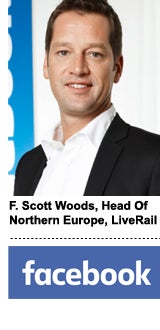
“Ideally, everything works very well together,” said F. Scott Woods, head of northern Europe for LiveRail and formerly a German country director for Facebook. “If we take people-based marketing to the advertisers and people-based marketing to the publishers, that should make it a better experience for everybody, beginning with the consumer.
Beyond its status as a third-party video ad server for Dailymotion, Hulu, A&E Networks and Major League Baseball, LiveRail is also the MVP of parent Facebook’s new mobile exchange.
Woods oversees business relationships with publishers, broadcasters and app developers in northern Europe for LiveRail.
“I started my career at Axel Springer, so I found it appealing to take what I learned at Facebook and apply it to the publishing ecosystem with LiveRail,” he said in an interview at DMEXCO in Germany. “Facebook is in a really interesting phase because we have so many developments outside of the core blue app. “
Woods discussed how LiveRail is impacted by the global programmatic climate and where buyers are investing. (Hint: It’s not connected TV yet.)

AdExchanger: Can you update us on LiveRail’s assimilation into the broader Facebook stack – Audience Network and Atlas?
F. SCOTT WOODS: Atlas is very focused on agencies and clients, and LiveRail is very focused on the publisher ecosystem. Publishers can be very broad. You can be an app developer, video developer, etc., but [Atlas and LiveRail] are the two parts we’re taking to market.
You recently expanded LiveRail’s backbone to power things like mobile in-app formats.
Obviously LiveRail’s DNA and heritage was in the video space, which we’re very much focused on. Video is one of the booming bits of the Internet as opposed to display, which has kind of settled. We’re focusing very much on mobile as well, and rolling out with partners now our mobile system. Underlying all of that is people-based marketing, and giving publishers the opportunity to sell to buyers the way Facebook sells, based on age and gender.
Over the last few weeks and months, we’ve been busy migrating a lot of the tools and systems in place to make sure we can actually make (people-based marketing) happen. With both parts, the age and gender piece and mobile … we’re in test mode with a few partners right now. We’ll be in test mode over the next months as we onboard more partners into the beta system.
We’ve heard that connected TV supply is fairly nascent in the US. Does the same hold true for Europe?
It’s on a lot of people’s minds for the future, but probably not the most important thing to execute on now. The opportunities still are larger with desktop video and mobile video, but pretty much everyone I talk to on the publisher and buyer side sees it as the future. It’s a great thing LiveRail is already in the space, so we’ll just have to keep building on it.
I’d say for traditional and multiscreen publishers, video is very much on their mind, not just from a monetization standpoint, but [in terms of getting] more video inventory and distribution. Mobile apps are most on their mind, because it’s something most publishers haven’t figured out yet. Mobile web feels a little like regular web, but in-app is one area where we feel we have a big advantage drawing from the Facebook experience.
How is Facebook audience data benefiting LiveRail’s core publisher network?
If I’m a publisher or broadcaster and an agency or client says, “I have this huge campaign targeted to women 24-34 – what can you do for me to make sure I hit my target group?” – they don’t actually have a lot of good tools to actually do that. It’s a lot of assumptions around shows using classical proxies people have used in the past.
Now, you can actually ensure on-target delivery. The average on-target delivery based on Nielsen’s 60%-plus figure is the industry average, but we can do well over 90% average. For the consumer, people get advertising targeted to them and are less likely to reject it. If there’s less wastage, it should command higher CPMs because the advertiser will get more value for hitting the right people. That’s the big benefit for everyone in the chain.
Are you forging more deals with TV publishers?
Video on Facebook is evolving and growing. First we were very text-based and then moved to image-based sharing. The evolution has moved on to video. The prime example was a year ago when the ice bucket challenge took place and we had billions and billions of video views. Video’s taking a more prominent role in the overall ecosystem as well. Coming from my background on the Facebook side, a lot of research we’ve done has shown classic linear TV as well as Facebook enhance each other really well. I don’t think it’s an either/or thing.
What’s the programmatic video opportunity for Europe?
You have a few progressive markets and a few laggard markets. Progressive would be the United Kingdom, France is actually pretty far along and then you’re seeing the Netherlands and Scandinavia come onboard with a bigger appetite for programmatic. They’re understanding this will be the way the world works in the future. Germany is a little bit of a laggard, but when you look at projections for programmatic buying in Europe, the UK is at about 60% and so is the Netherlands, while Germany is like 30%. So it’s a lot of evangelizing still and making sure people understand the benefits of programmatic and educating the market.









