

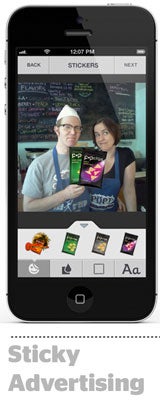
 While they may seem frivolous to some people, digital stickers — small emoticons and images that can be sent in chat messages — are gaining traction as a viable marketing tool. Facebook and app developers in Asia, where digital stickers first became popular, have rolled out numerous stickers and more companies are following suit.
What makes stickers attractive are their engagement factor and ease of use, according to Michael Parisi, SVP of marketing for the snack company Popchips. “Brands want to connect in an authentic way with people and a lot of times digital banners don’t do it,” Parisi said. “Fans sharing stickers is much more appealing in many aspects.”
Popchips tapped social-media marketing company RadiumOne to help it develop stickers representing different chip flavors, using the company’s new Photo Effects suite, which includes stickers and photo filters.
As users share the free stickers, Popchips can use that data for insight into which flavors are preferred or less popular with customers, according to Parisi. “What we’re looking for is how much interaction is going on, what are people sharing and other data like that. This gives us a new chance to observe and measure our interactions [with consumers],” he said.

Parisi said he was attracted to RadiumOne’s Photo Effects for its ability to integrate across various mobile applications and reporting capabilities. For now, the company is not using any other sticker providers, such as Facebook, which recently unveiled a Sticker Store.
Parisi downplayed the effectiveness of recent changes to Facebook’s algorithm. “If you post something on Facebook,” he said,”it’s only going to show up on your specific network, whereas here we can get something in front of RadiumOne’s 125 million users.”
While RadiumOne said it was too early to share ROI stats around its stickers, the messaging app Line has earned approximately $17 million or 30% of its revenue in Q1 this year through stickers, reported The Next Web.
In addition to building brand awareness and using it as a market-research tool, brands can earn revenue by selling the stickers. Some brands, such as Hello Kitty, plan to sell the stickers to their users, said RadiumOne mobile VP Kamal Kaur. “Besides using them to aggregate data, some brands are opting to sell the stickers for, say, 99 cents for 10 stickers as another revenue stream,” she said. “However brands decide to do it, stickers are another opportunity to stay front and center in a creative manner.”






