

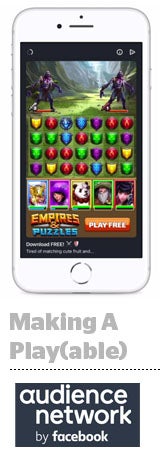
Facebook is bringing playable ads, an interactive format that lets users demo a mini version of an app before downloading it, to Audience Network starting Wednesday.
It’s available within rewarded video and interstitial placements.
In the coming weeks, Facebook is also planning to expand access to its rewarded video unit to all publishers across the Audience Network. Until now, developers could only monetize via rewarded video on a case-by-case basis after being vetted by Facebook.
Official creative marketing partners for both units include Bidalgo, TreSensa, CrossInstall, Smartly.io, Synative, MakeMeReach, Wisebirds, ZingFront, Septeni Original, CyberAgent, Craftsman+, Kaizen Platform, AdLiven and Soft-World.
Facebook first introduced playable ads into the news feed in August of last year and immediately saw strong results for advertisers, said Yoav Arnstein, product marketing director of publisher solutions in charge of Facebook’s Audience Network product.

People who install an app through a playable ad open the downloaded app 60% more often than people who installed the same app after clicking on a non-playable ad, according to a report conducted by research agency Walnut Unlimited on behalf of Facebook.
Users acquired through playables are also six times more likely to make an in-app purchase, which demonstrates the fruitful interplay between different app monetization methods, Arnstein said.
To support its playable push, Facebook also introduced three new metrics, one to track when a user clicks to start engaging, another to track active engagement with the interactive components of the ad and a third to delineate how much traffic the ad is driving.
“Because there’s more engagement built into the market, it invites more interactions, and we know advertisers will want those numbers so they can optimize creative and get learnings that go into the next campaign,” Arnstein said.
Playables work – if they’re designed properly and are clearly marked to the user as interactive – because they can feel like a natural part of the game play.
“The right way to do this is to balance the user experience and the game experience, meaning that the user can engage with something that isn’t disruptive but that also drives advertiser outcomes,” Arnstein said.
Although Facebook was a bit late to the game – playable units have been used since at least 2014 – it hopes to make up for lost time.
The total number of active gaming publishers on Audience Network grew by over 1.5X in 2018, and payouts from rewarded video alone increased more than eightfold. Arnstein declined to share hard numbers, but did note that when CPMs pop, Facebook takes notice.
“At the scale we’re running today, our benchmarks are stable,” Arnstein said, “so when a format comes and generates an increase like that versus the baseline, we feel like it’s an attractive proposition.”







