 “Data-Driven Thinking” is a column written by members of the media community and containing fresh ideas on the digital revolution in media.
Today’s column is written by Scott Portugal, CRO at TRAFFIQ.
Transparency and Value, Value and Transparency. The Ying & Yang of digital media and two concepts that are embedded into nearly every conversation going on in the space today. We discuss transparency in the spirit of placements and data – who is the user, what is the data source, and where is the ad. But in the next breath, we discard the “value” of transparency for the “value” of efficient audience buying. And audience buying at scale is blind. Any way you cut it, independent audience buying platforms simply must be opaque in order to protect their value. As Kevin Bacon said in A Few Good Men, “those are the facts of the case and they are not in dispute.” (Terry Kawaja’s not the only guy who can link a Rob Reiner movie to real-time bidding).

So, in order for these platforms to glean placement & cookie level data that can be cycled back into their machines to drive better bid & delivery optimizations, transparency must be sacrificed in the name of delivering value.
Now think about the famous “CPM degradation” slide (PDF here) from Tolman Geffs at JEGI:
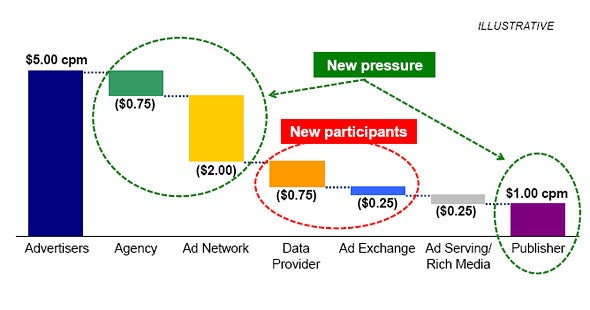
Most reactions I’ve heard to this slide have been either joy that they aren’t a publisher or annoyance that an advertiser receives 20% of the “value” of their end dollar that could be better spent by simply working directly with the publisher in the first place. Yet I have an entirely different reaction: This feels right, and it’s a great reflection of transparency and value working together. It’s a seemingly incongruous concept that transparency & value aren’t the same thing, and the more we can pivot the conversation about transparency into a conversation about value, the more this chart will feel right to everybody else.
Transparency in the name of the placement is simply one definition of the word, but it’s the narrowest. What we should be discussing is “value transparency”, as it will do more to benefit all vendors in the space (and it feels like vendors outnumber publishers). Value transparency is more difficult to quantify, but it’s a factor in the media equation that is necessary to justify working between the buyer and seller. It’s as much a sales concept as it is an operational concept, but the better we do in quantifying this “value transparency”, the more comfortable the Advertisers will be in having their agencies work with multiple parties to deliver a single ad. An example:
Advertiser CPM: $5.00
Agency fee = 10%, remaining CPM is $4.00
Ad network CPM = $2.00.
- Ad network buy includes 50 sites in custom channel and guarantees above the fold placements. They absorb the costs of verifying these placements ($1.00 CPM), and are able to achieve campaign KPI’s ($2.00 CPM value). Thus their transparent value is actually $3.00, achieving positive ROV (return on value) by verifying appropriate placements, hitting goals, and delivering efficiency against a custom site list.
Publisher CPM = $1 (post ad network profit and ad verification system usage).
- The publisher served the ad, but was only included due to targeting and verification used by the ad network partner. Without these included, the publisher would be able to deliver a fraction of the ads (due to a finite amount of cookie targeting) and absorb the verification costs. When you factor in additional COGS and the future benefit of demonstrating to that advertiser and competitors of that advertiser the ads running on their site, the value of the $1 CPM could very well be higher than it initially seems.
Clearly, this example is loose and less-than-scientific. But the point remains the same – by doing a better job of quantifying value beyond simply click/conversion rates (this includes brand attribution data, better conversion data, and a transparent approach to agencies about how & where data is coming from), vendors will make advertisers comfortable with their role in the CPM chain. Publishers will also be able to better understand the value of vendors beyond simply net CPM or basic yield improvement, and be more comfortable with leveraging all available toolsets in the market that aren’t directly cannibalistic. The transparency discussion we need to start talking about needs to expand, and it’s up to all of us to evolve the definition of transparency & value as fast as we’re evolving the technologies delivering the value in the first place.
You can follow TRAFFIQ (@TRAFFIQnews) and AdExchanger.com (@adexchanger) on Twitter.