 “Data Driven Thinking” is written by members of the media community and containing fresh ideas on the digital revolution in media.
Today’s column is written by Nikhil Sethi, who is co-founder/CEO Adaptly.
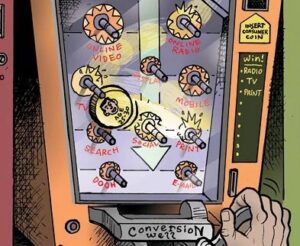
As we look at the emergence of social as a serious contender within a typical media buy, the marketplace is noticing an evolution of the medium rather than the creation of yet another new channel (e.g. video, mobile, etc.). Looking at the four seats of advertising we have our three traditional seats (Radio, TV, Print) and of significant importance in the past decade (Digital). Traditional media has always suffered from the untraceable nature of the beast, whereas Digital, by means of Display, and Search primarily has built itself on its trackable nature, put simply the ability to cookie.
And here comes Social.
Emerging truly as a digital vehicle (meaning it plays in the overarching web and mobile space), Social has presented itself as the FIFTH seat. It ignores most concepts that Digital has been born with. It plays kindly with the traditional metrics (clicks, impressions, CTR), but also embodies a very new idea around conversation, dialogue, and response metrics – creating value in an owned and earned media sense.
The game is not only about distribution anymore, it is now 1 part distribution, 2 parts
engagement.

Who owns Social?
There is significant turmoil within a given agency in terms of ownership around Social.
Because of the separation of Social from Digital, we have several groups from the
digital, PR, branding, and offline teams all seeing budget emerge for social buys.
The problem lies in the perspective each group has for the space.
As Social emerged it began to look like biddable media, based on a campaign to ad unit structure. The first players to jump on the bandwagon were the SEO/SEM platforms.
They essentially looked at social (Facebook) as an extension of direct response inventory and mapped it back to direct response metrics similar to what they have been doing with search for many years.
It became simple for a search group within an agency to mask their social ad buys directly with their search efforts.
Optimizing for Engagement
However the landscape has evolved. No longer are startups alone attempting to penetrate offline dollars, no longer are startups alone constrained by the current set of metrics we have available to work with. The publishers themselves (Facebook, Twitter, LinkedIn, etc.) have made the corresponding changes at the supply level.
As KPIs shift from DR to conversation, the methodology and thought process needs to shift as well. No longer is CTR the godlike metric for optimization – we need to begin to optimize for engagement.
Two new forms of media emerge: Owned and Earned. Within these groups engagement can be defined as any action a consumer can take on a given social platform from tweeting, retweeting, stumbling, liking, posting, sharing, and commenting.
Each of these metrics becomes part of the soup of metrics that all of our paid media on social should report, and optimize towards.
Social is not search and needs to be planned, executed, and reported upon differently.
Follow Nikhil Sethi (@nsethi), Adaptly (@adaptly) and AdExchanger.com (@adexchanger) on Twitter.