
 “Data-Driven Thinking” is written by members of the media community and contains fresh ideas on the digital revolution in media.
Today’s column is written by Oisin Lunny, senior market development manager at OpenMarket.
Our love affair with mobile devices shows no signs of diminishing. There are already more mobile devices on the planet than human beings, and analysts say the global scale of mobile device adoption is only going one way – upward – but on a j-curve so steep it looks almost vertical.
This rise in mobile device adoption and mobile network rollout is driving the new wave of global connectivity, which will change how we interact with brands and the world of consumer devices around us.
The intensely personal nature of our relationship with our mobile devices, for example, is staggering; we are truly smitten. Even back in 2011, two-thirds of us went to sleep beside our smartphones and checked them first thing every morning.

Our imitate relationships with our devices means that “spray and prey” marketing is a thing of the past because consumers simply won’t tolerate it anymore. In response, major global players are adopting new ways of using mobile for everything from customer service to HR notifications, all of which is informed by crystal-clear, data-driven mobile analytics.
Better Connectivity, Higher Customer Expectations
Mobile adoption is changing consumers’ behavior and expectations, which in turn drives a rapid agenda of business change. Traditional customer service no longer meets the mark for modern consumers, and today’s companies must be able to reach their customers on preferred channels.
Some 64% of consumers prefer to use texting over voice when it comes to customer service, while 44% prefer to send a text rather than waiting on hold for an agent.
Smart companies are adapting to these changes and deploying short message service-based solutions for customer service, such as text-triggered callbacks, interactive information gathering before a support call and surveys after the call, according to Harris Interactive. Critically, this all happens on a consumer’s mobile device, and they prefer it this way, as 77% of consumers aged 18-34 are likely to have a positive perception of a company that offers texting.
Smart data-driven marketers will look to leverage the public’s positive text preferences to improve perception and, ultimately, revenues. A happy customer is a repeat customer.
On The Horizon
Today’s concept of connected devices extends way beyond the portable supercomputers we carry in our pockets, which happen to make the occasional phone call. Discrete components of our lives, such as clothes, jewelry, watches, wallets, fridges and even forks, are “talking” to each other and to us.
The Internet of Things (IoT) has given birth to buzzwords such as wearables, nearables, hearables and payables. Early IoT techologies ranged from ingenious to hilarious. While NikeFuel brought genuine value to millions of people, the jury may still be out on the Huggies “TweetPee,” a device that sends a message to parents when their baby’s diaper needs changing.
In many cases, the IoT uses technology that has been deployed to underpin mobile device adoption. The Apple Watch, for example, relies on the iPhone for access to the full set of controls, while machine-to-machine messages can leverage the global ubiquity, reliability and scalability of short message service (SMS).
Today, you might see an outdoor oil tank send its owner an SMS when it is running low or a home electronic device let the purchaser know by text message that it’s time to renew the warranty. These examples leverage mobile in new ways to radically improve efficiency and customer experience.
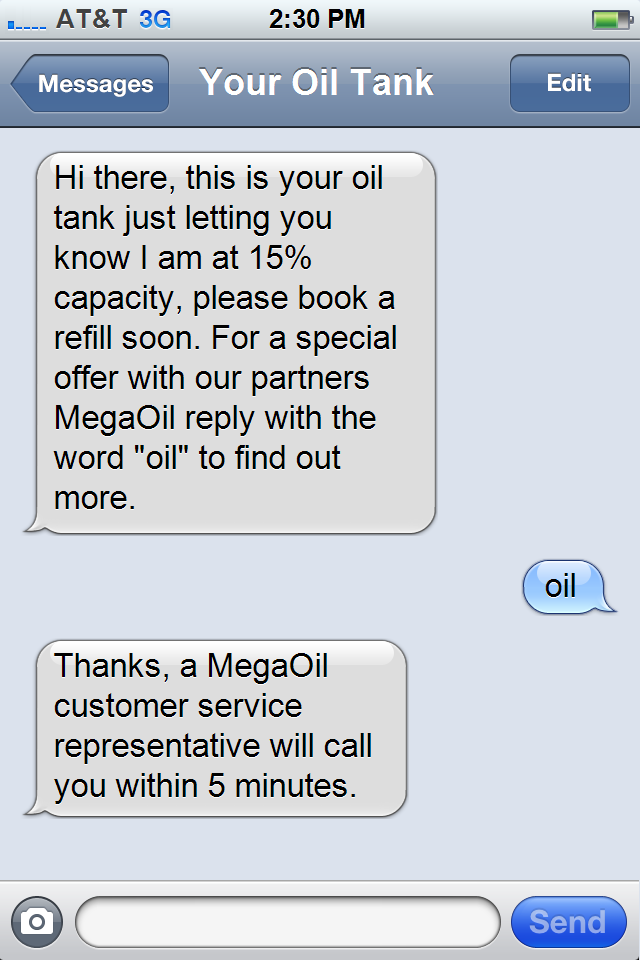 Recipients benefit from click-to-call options within text messages, and they can respond to two-way interactive SMS messages for value-added purchases, queries or callbacks. For data-driven marketers, this is a marketing opportunity that is so highly targeted that it feels like VIP service to the consumer.
One important form factor of mobile devices is that they are innately transactional, either through mobile network payments from a phone bill, such as a charitable donation, by using a smartphone app such as Uber or via an SMS-triggered credit card or bank transaction. Given the new behavioral and contextual finance models of apps like Moven, one can see consumers opting in for promotional opportunities based around their spending behavior. This is another opportunity for highly targeted, data-driven mobile messages to provide the bridge between consumer behavior and marketing opportunity.
Another form factor is mobility, as mobile devices can power unique interactions anywhere and anytime, battery life permitting. Apple’s typically astute combination of the iPhone, Apple Watch, iBeacon and NFC, in one seamless ecosystem, for instance, could have the same revolutionary effect on retail that iTunes had on digital music. Gaming and gambling giant GTECH are already planning to introduce iBeacon for use at lottery retailers to power personalized notifications and promotions.
Business processes are also riding the wave of mobile-powered transformation, as SMS has been the perfect M2M communication channel to trigger choreography flows for warehouses and fleet management. Meanwhile, marketing, advertising and customer service professionals can use messaging within a department for harmonizing employees and processes. Team leads within these departments can use SMS platforms to enhance their multichannel communication needs and ensure teams are synchronized by using mobile messaging to send updates on tasks related to projects or goals.
The surge in the adoption of mobile devices has liberated consumers from experiences that were chained to a fixed line. For global enterprises, a robust mobile engagement strategy is no longer something that is nice to have, tucked away in R&D. It’s an essential part of every business plan, whatever the sector.
The mantra of “know your customer” has been around a long time, but with the advent of our love affair with the mobile device and our impending marriage to wearables, such as the Apple Watch, it’s never been more relevant for marketers.
Follow Oisin Lunny (@oisinlunny), OpenMarket (@openmarket) and AdExchanger (@adexchanger) on Twitter.









