 “Data-Driven Thinking” is written by members of the media community and contains fresh ideas on the digital revolution in media.
Today’s column is written by Victor Wong, CEO at Thunder Experience Cloud.
After investing in big data for the last few years, enterprises found themselves drowning in so much data that they didn’t know what to do with it all. These corporations bulked up on data lakes for storing all their raw data; data scientists and analysts for data processing and customer data platforms; and data management platforms for data activation.
Yet, a critical assumption behind these investments in data-driven marketing was that the marketer owned the advertising data generated by a campaign – or at least had access to it. If they weren’t going to get the data, why bother making such major investments?
The first half of 2018 challenged this fundamental assumption and raised this critical question. In that time, Facebook faced the Cambridge Analytica scandal, leading it to raise the walls on data partners and further limit data sharing with advertisers. The entire ad industry now faces the General Data Protection Regulation (GDPR) in Europe, where just collecting and receiving information exposes enterprises to liability and risks that didn’t exist before.
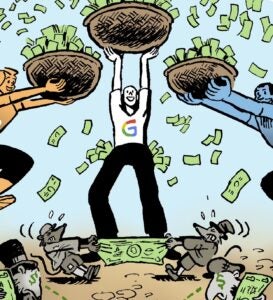
In response, Google announced that it would block ID sharing in advertising data that is transferred out of its cloud, beginning in Europe, but ultimately launching worldwide. Data is increasingly staying not with the buyer, but with the seller.

In effect, brands are being asked to pay for advertising that generates data that will only exist on their media supplier clouds. They are increasingly not able to gain access to the data without limitations and dependence.
If brands cannot collect information on who saw their ads, they cannot be confident in their marketing results. Without this advertising data, they can’t verify ad delivery, control frequency or measure impact across their ad spend. Damming the data flow risks the whole surrounding ecosystem and its sustainability – in this case, the ad tech and digital media ecosystem.
Worse, brands are being asked to upload their own proprietary data into these ad platforms if they want to do any sophisticated analysis or modeling. Data is, in fact, flowing in reverse!
Brands now must decide on the future of their data investments. Is having data independence critical or can they trust their data and future with their media suppliers? How will they keep data flowing?
What was once a rich pool of data usable by a number of marketing applications, such as data management platforms, multitouch attribution providers and analytics solutions, is now increasingly being reduced to a puddle for anyone not investing in new ways to keep data flowing.
The answer is looking like a trade of greater ad dollars in return for transparency or data flow, facilitated by a technology safe harbor that is neutral. Nobody wants a middleman siphoning off the resource or profiting on the side through unknown parties – yet, with both sides increasingly suspicious, someone needs to hold everyone accountable.
While brands may be upset paying for data and services that were once free, just as people would be upset paying for tap water, in a world of greater scarcity they are beginning to realize just how valuable this commodity is and that it must be protected to keep everyone satisfied.
Follow Victor Wong (@vkw), Thunder (@MakeThunder) and AdExchanger (@adexchanger) on Twitter.