
“Data-Driven Thinking” is written by members of the media community and contains fresh ideas on the digital revolution in media.
Today’s column is written by Maja Milicevic, co-founder and principal at Sparrow Advisers.
While most ad tech and mar tech companies will seem like a classic B2B technology marketing use case, it’s easy to underestimate the additional curveball of marketing to an audience of other advertising and marketing professionals who are well-versed in the usual persuasion tactics.
Typical responsibilities for a marketing leader at the C-level are usually both externally and internally focused. An ad tech CMO will need to ensure that they’re raising the visibility of their company in-market and articulating clearly what the company does. This will require a mix of brand-building, thought leadership, sponsorship and stage time at marquee conferences, and other content creation activities that may or may not include product marketing, depending on how the company is set up and who is internally responsible for this function.
Internally, an ad tech CMO needs to assume the role akin to that of an orchestra conductor and ensure that the sales and account management teams have the right support, a solid lead nurturing or account-based marketing approach and oversee the company’s own marketing tech stack. It’s a lot of ground to cover. Given the sheer breadth of responsibilities, how does one go about acquiring the right set of skills and experiences to succeed?
Marketing objectives are different across many different dimensions, but arguably the most relevant to the type of skills your marketing leader will exhibit and develop is your company stage.

Startups
If you’re a startup – and for the purposes of our marketing function framework, those are companies with less than $15 million in annual revenue – the main task of anyone occupying a marketing function is to gain traction in-market. This may manifest itself as building customer acquisition channels, architecting the lead generation or account-based marketing processes, and liaising closely with sales to ensure the team has the right field collateral and is able to produce new versions and iterations rapidly.
You’ll also need to build the first version(s) of your brand and ensure that your company is classified in the right categories in analyst evaluations and various popular industry landscape charts. Your outlook and focus is likely in three- to six-month increments; planning beyond that may not be realistic given the need for rapid adjustments and being as nimble as possible.
If you’re raising venture rounds, your marketing leader may need to be crafty at presenting at board level and articulating planned marketing efforts and strategies for an audience of investors, too.
The scale-up
The next company stage is a scale-up – for the purposes of this framework those are companies in the $15 million to $100 million annual revenue range.
At this stage you’re typically rolling out multiple product lines to market, and your marketing leader needs to focus on differentiating against the competition, crafting the company story, orchestrating a pipeline of customer success stories and scaling up every marketing process. At this stage it’s less about day-to-day execution and more about process and capacity building and scaling.
The outlook should typically be six to 12 months out.
Mature companies
In mature companies – those with more than $100 million in annual revenue, marketing leaders operate to fulfill the needs of many constituents, including customers, partners, internal audiences or other business units. The role skews more external: There’s a bigger pull to raise the visibility of the company through regular conferences and events while managing the complexity and operating budgets effectively.
Marketing leaders in these types of companies really have to act as the glue between other business functions and provide a consistent voice to market. The outlook is typically nine months out or more.
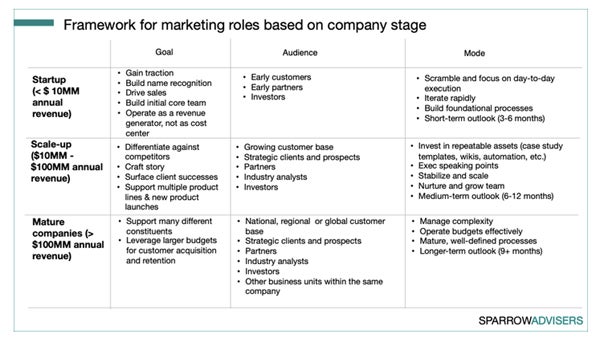
While it is tempting to think of marketing as a somewhat monolithic discipline (my partner surfaced a similar challenge with product roles, and I’ve previously tackled how this manifests in sales leadership) marketing roles and expertise are multifaceted.
This is an important consideration when hiring: A startup’s marketing challenges are different than a mature company’s, and someone with experience in the former may not readily translate to success in the latter.
It helps to break down not just the skills needed and company stage but also which functions you want to maintain in-house and which can be outsourced. The same applies to capacity building: If you know you’re about to transition to a new stage, make sure your marketing leaders have the right coaching, guidance and support so they can skill-up as needed.
Follow Maja Milicevic (@SparrowMaja) and AdExchanger (@adexchanger) on Twitter.