 “Data-Driven Thinking” is written by members of the media community and contains fresh ideas on the digital revolution in media.
Today’s column is written by Oren Harnevo, CEO and co-founder at Eyeview.
Last year, I was one of about 50 judges for a prestigious advertising award and one of the few without a creative or TV background.
The judges included top marketing execs from the world’s largest brands. We were instructed to judge on the quality of the campaign creative brief and, more importantly, campaign performance.
So, I was surprised when nearly all the judges began scoring entrants on their subjective critiques of the creative while completely ignoring performance. It was clear that the award winners would be determined by the judges’ opinions of creative, rather than the official award criteria.
Working with creative agencies every day, I see this a lot: creatives who place high value on aesthetics and very little on how it contributes to real business outcomes. The problem is that clients are more interested in results than in advertising awards. It seems to me that creative agencies are working too much from the heart and not enough from the head.

In the awards competition, one campaign entry exceeded all others for impact. It was a small Midwestern destination whose campaign featured simple graphics and copy that its creative team thought would drive more visits. And it worked: They saw a measurable increase in visitors as a result of the campaign. The creative brief was straightforward, and the campaign’s performance exceeded that of any other campaign we judged. In my opinion, it was a strong contender.
But my fellow judges immediately shot it down due to the quality of the graphics, dismissing it primarily due to long text, overly simple creative execution and font sizes. Font sizes!
They’ve got it all wrong. Clients may want beauty, but they need results. Results are what will keep clients coming back to an agency.
Data Drives Better Results Than Gut Feelings
Many industries that traditionally got by on gut feel have been revolutionized by data. Michael Lewis’s great book “Moneyball” detailed how the Oakland A’s outperformed teams that spent more money on players by leveraging data to pick theirs.
Data-based approaches are moving well beyond sports to other fields, including medicine. In 2015, Stanford researchers explored whether an artificial intelligence–driven neural network could diagnose skin cancers more accurately than physicians, based on photographs. They reasoned that if a physician can do it by sight, a machine should also be able to. The researchers trained the system using more than 100,000 images, including those of correctly diagnosed cancers. Then they ran a test of the model versus two board-certified dermatologists. The model was right 72% of the time, compared to 66% for the physicians.
The experience of the Oakland A’s and Stanford researchers shows that data drives better decisions. I believe the creative industry is ripe for the next data revolution.
Catering Messaging To Customer Segments
How can creative agencies do a better job using data up front? Well, you start with hiring fewer cool kids out of art school and more data analysts.
Agencies should look first to their clients’ own customer segments to develop distinct brand stories for those segments.
This will help identify granular elements of the story worth experimenting with, such as brand messaging, promotions or calls to action, in order to test what resonates with specific audiences.
Then, they can look for the best matches between segments and stories by indexing one against the other. When an index falls below 100 for certain ads in certain segments, for example, there is less interest in the product. If it soars into the 150s, there is a 50%-plus increase in interest. With this insight, the brand can determine which ads are worth putting in front of which segments and extrapolate results with larger-sized segments.
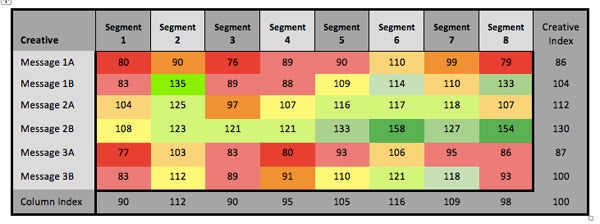
So, by starting with the data, the brand can achieve better performance on top of the original generic brand asset.
Putting Data First
Forward-thinking brands and creative agencies are giving their data jockeys more input when it comes to campaign creation. The ideal data-driven campaign will use data to determine which customers to target and will leverage data to determine which messages are likely to drive action with specific audiences.
Marketers should test messaging against audience samples and measure their index of interest. The creative should be produced based on data, rather than esoteric creative concepts. And marketers should never stop optimizing targeting, messaging and creative to deliver the best results across all screens.
So, Does Creative Not Matter?
I’m not suggesting that creative should be sacrificed entirely – advertisers shouldn’t have to choose between beauty and results. Data-driven campaigns can also feature stunning, high-quality creative. What I am saying is that if I had to pick one or the other – beauty or results – I’d pick results all day long.
Brands should ask their creative agencies about the role that data plays in their process and ensure that their creative teams are focused on driving outcomes rather than awards. Data should play a role in all stages of a campaign – informing the creative up front, testing concepts midway through to see what works best and measuring results on the back end. And agencies should think hard about whether their ratio of beauty to results still makes sense in an era of ubiquitous data.
Follow Eyeview (@EyeviewDigital) and AdExchanger (@adexchanger) on Twitter.