“Data-Driven Thinking” is written by members of the media community and contains fresh ideas on the digital revolution in media.
Today’s column is written by Eric Wheeler, CEO at 33Across.
Economic downturns are both cyclical and inevitable. Since getting my first advertising job in 1993, I’ve been through a few recessions. With the exception of Sept. 11, 2001, most are relatively easy to spot.
It’s usually a perfect storm that builds with a general slowdown in the economy and some national or global instability. We are certainly witnessing signs today – including a US–China trade war and instability in major global markets, such as the United Kingdom potentially exiting the EU with no clear plan to transition.
Although a recession isn’t guaranteed, a downturn in 2019 could shake up ad tech.
To prepare, weather and thrive in a recession, we’ve got to tighten up everything: costs, operations and, most importantly, our ability to deliver on real outcomes. The companies that can articulate and deliver a business impact have a much higher chance of capturing marketing dollars when they’re tight.

What a recession could do to the current model
While there is a lot of crowing that comes with a downturn, it reinforces what we already know: Companies with solid value propositions and scalable businesses will be fine, while those without, won’t. When a recession sets in you’ll see ad budgets tighten and approved vendor lists shrink, but I predict we’ll see relative programmatic growth accelerate.
Media waste is a big issue, but even bigger during a recession. The ability to constantly trim, optimize and improve media plans to minimize waste, improve overall efficiency and drive results are unparalleled in programmatic. We’re talking about the ability to make decisions in milliseconds, instead of weeks or months. EMarketer already predicts that 84.5% of digital dollars will flow to programmatic by the end of 2019.
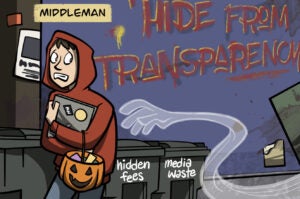
The flight to quality will accelerate in a down market as there will be greater access to direct quality supply at reasonable prices. It will force middlemen out of the picture and highlight uniqueness. We’ve also seen interesting data around time in view and how it drives greater brand and direct response outcomes, and I expect marketers to lean harder into offerings that move the needle on business outcomes.
Since efficiency is key in a recession, marketers will adjust their supply strategies to further increase their digital investments and protect themselves against fraud. It’s not coincidental that budgets are moving away from private auctions and embracing supply-path optimization to find more direct and efficient routes to quality inventory without the hidden fees.
A push toward transparency
A recession would likely create further incentives for increased transparency. The one-for-you, two-for-me mentality won’t fly when dollars are scarce. With more control, access and efficiency comes the need for greater transparency, not only for understanding results, but for understanding specifically what components of the media plan and programmatic stack are driving value and at what cost.
In almost every case, buyers will choose the transparent path over the obscured path with their recessionary spending. Nobody wants to be stuck with an opaque guaranteed deal when times are tight. We’ve all been there.
Another area to explore is strategic partnerships with noncompetitive companies. Can companies share market costs, co-host events and possibly package their offerings together for clients? Budgets are more likely to be scrutinized from all angles in a recession, so companies must be prepared to show how and where they bring value into the supply chain.
We also need to stop fearing Google, Amazon and Facebook. These three powerhouses have embedded leverage, but they are large, and the market favors speed and executional brilliance no matter what. Still, distrust of big platforms has risen recently; companies should consider how can they use that to their advantage to grow market share.
Perhaps the greatest thing to remember is that the definition of insanity is doing the same thing and expecting a different outcome. In a recession, insanity can also mean doing the things you used to do in a strong market and expecting the same results in a recession. Don’t be crazy.
Follow 33Across (@33Across) and AdExchanger (@adexchanger) on Twitter.