


You just launched a new campaign across multiple channels, from search to social. Perhaps you’ve gone out on a limb – maybe even against the recommendation of your CEO or board – and included streaming TV in the mix.
On the surface, all is well. The creative pops, the audience is dialed in and, before long, the sales start rolling in.
Thrilled with the results, you check your dashboards: clicks and conversions, oh my! The numbers are pointing to Instagram as the hero of this campaign. But dig a little deeper and a different story emerges. Those conversions? They aren’t the sole result of Instagram. Your TV ads are quietly driving results and making other channels even better.

Enter the halo effect
For marketers accustomed to precision targeting and last-click attribution on channels like social, the halo effect might sound unfamiliar. But it’s one of the most overlooked drivers of performance. The halo effect refers to the broader impact TV advertising has on other marketing channels.
In short, digital and email marketing drive many potential customers to your website, but if these visitors have also recently seen a TV ad, they are more likely to make a purchase than those who haven’t, according to research by the VAB and others. In a world where every marketing dollar is aggressively optimized, if you’re not running TV ads, you’re missing out.
Measuring the halo effect
Understanding TV’s halo effect starts with measuring how exposure to TV advertising influences performance in other channels. Advertisers often compare conversion rates (CVR) among website visitors who arrive via display, social or email campaigns, identifying how many ultimately make a purchase. By segmenting audiences based on their recent exposure to TV ads, it becomes possible to see whether TV is amplifying those other marketing efforts.
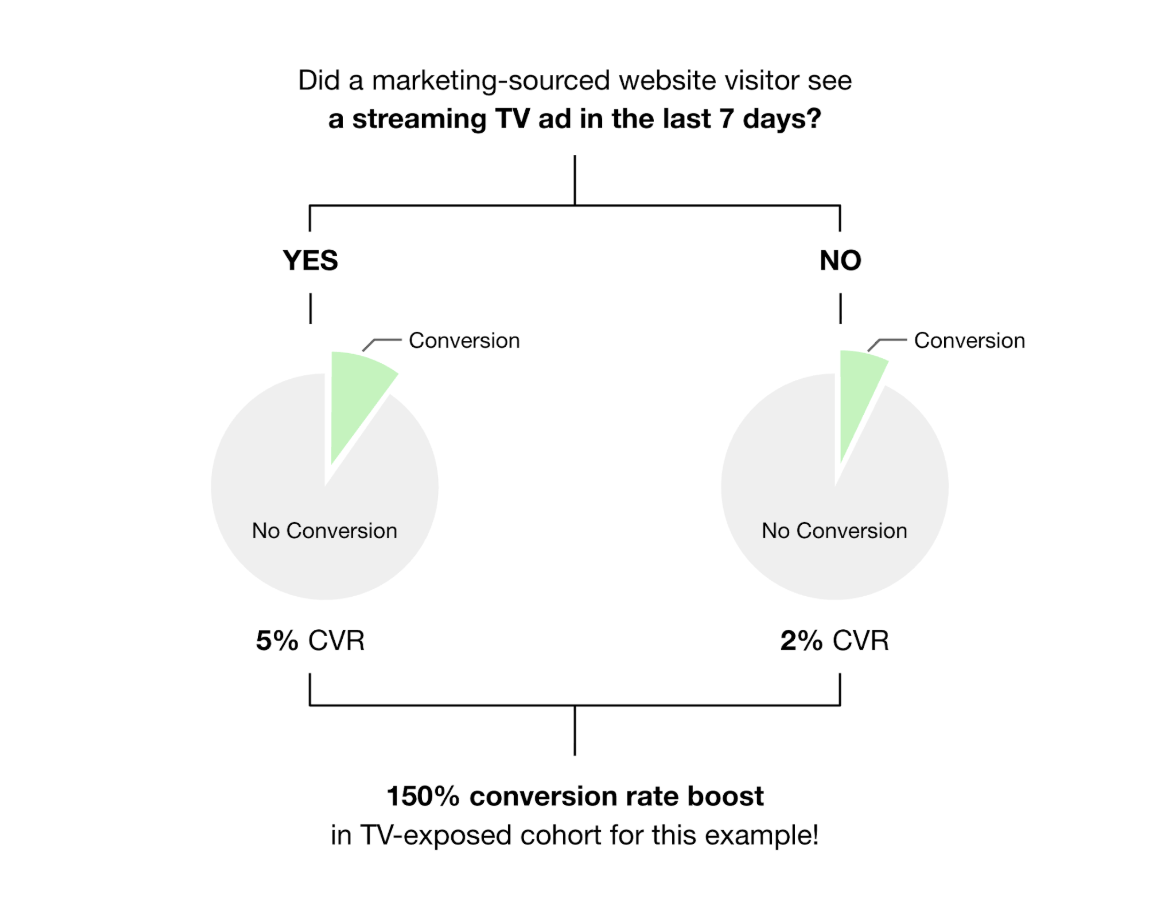
Tatari does this by dividing marketing-sourced traffic into two groups: those who viewed a TV ad within the last seven days (Group A) and those who didn’t (Group B).
When we measure the CVRs of these cohorts separately, we find a striking effect. For the vast majority of our clients, the CVR of Group A is significantly higher than the CVR of Group B. In fact, among 100 brands for which we measured this effect for social marketing-driven traffic:
- Nine out of 10 brands saw higher CVRs from website visitors exposed to TV ads
- 60% of companies saw a CVR lift of over 50%
- 33% saw a lift of over 100%
Analyses of email-driven and other traffic show similar results. This is just our approach to quantify the halo effect. When measured carefully, we believe TV advertising consistently drives incremental lift across all marketing channels.
The proof is in the data
Remember that campaign you recently launched and measured, where Instagram was your apparent winner? You may be tempted (or asked!) to shift your budget out of TV and back into all your digital and social channels. But doing that would mean missing out on TV’s halo effect.
In the modern multi-touch marketing landscape, growing your TV footprint not only increases your overall brand awareness but also positively influences your other marketing channels. Here’s an example of how we demonstrate this impact.
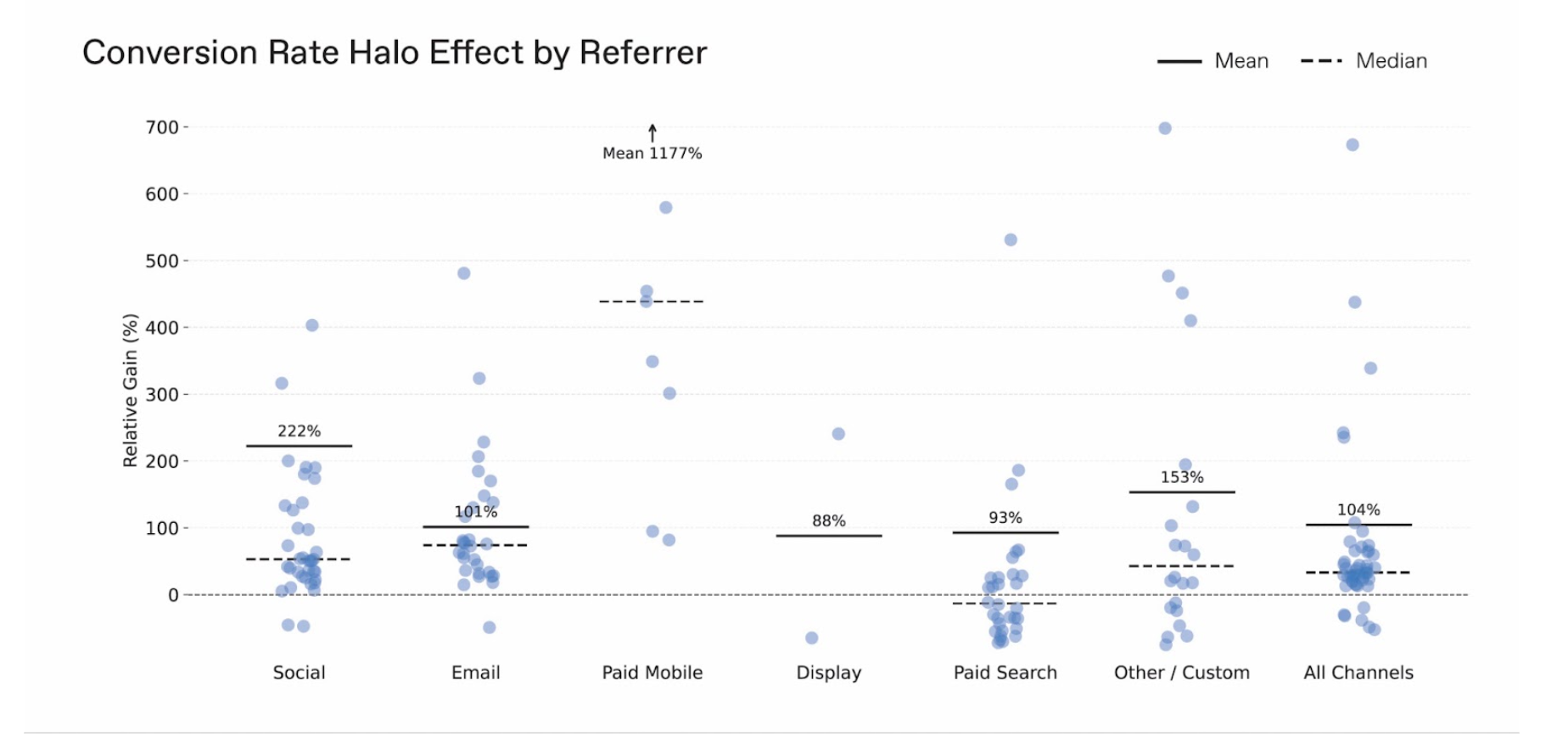
The figure shows that some of the biggest boosts are seen among visitors arriving from social referrers!
In this figure, each data point represents the relative increase in CVR that a Tatari client sees due to website visitors who have recently seen a TV ad. For example, a relative gain of 100% means that a website visitor who has seen an ad served by Tatari is twice as likely to convert than a visitor who has not seen an ad.
These data points are grouped by traffic referral source (where visitors enter the site). The lines in each group indicate the mean and median boost calculated across all companies with that referrer type. Social and email show a consistent positive signal across many clients, while paid mobile data suggests a potentially even stronger effect, though based on less available data.
Note: The vertical scale of this figure has been chosen to show most of the observed data. However, some companies do have boost factors significantly above the displayed range, resulting in higher mean values for some of the categories.
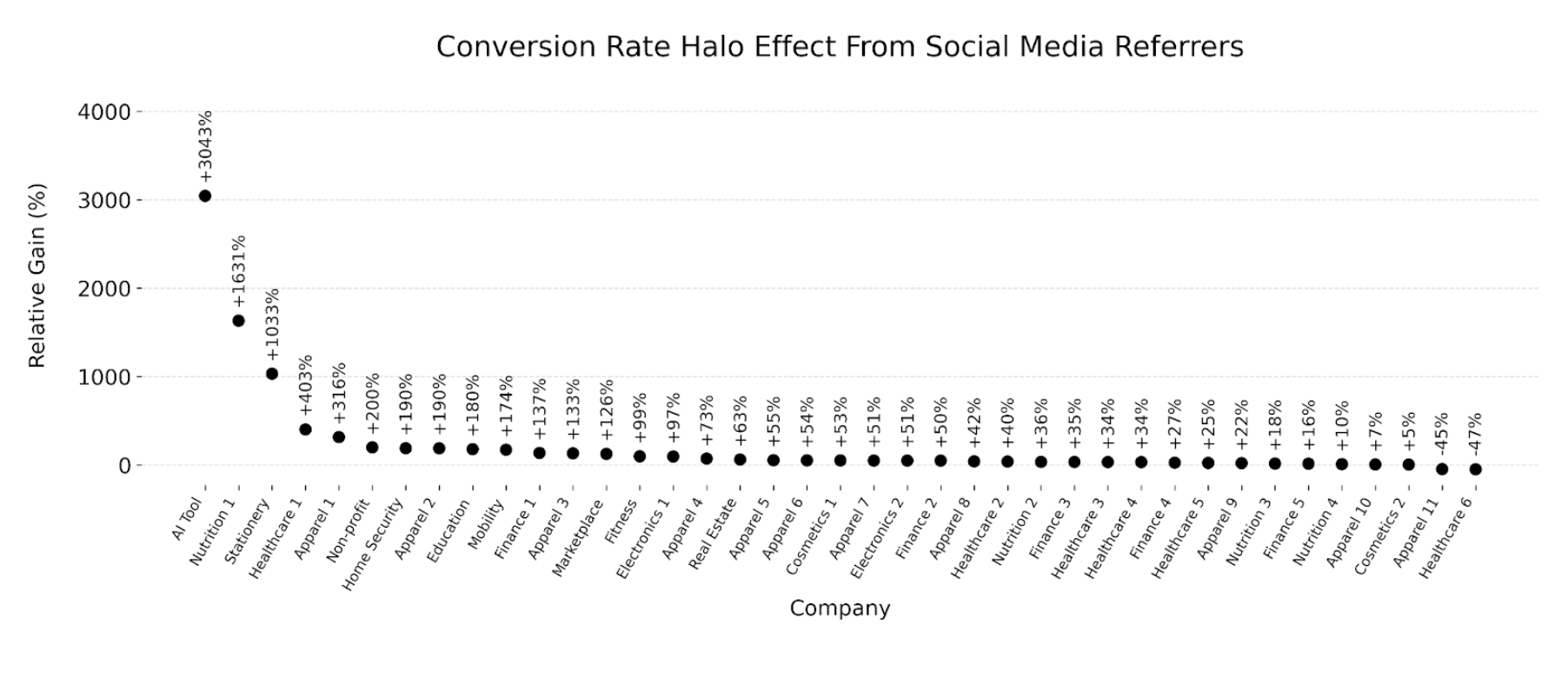
In this figure, we show the relative conversion rate gain from TV ad viewership for each of the companies with social media traffic we used for this study. Data from nearly every company across a wide range of industries indicates that TV provides a significant halo effect that impacts purchase behavior.
Harnessing the halo effect
Now that you know about the lift that TV can provide for all your marketing channels, how can you harness this knowledge? Structure your TV campaign not only for performance but for reach. The larger the audience you reach, the likelier it is that one of your ads will hit someone who is also being influenced by one of your digital channels and help convert that potential interest into a paying customer.
As the data illustrates, exposure to a TV ad can double or even triple your conversion rates.








