Home Brand Aware Kellogg’s Bob Arnold Starts ‘Brand Aware’ Column

Kellogg’s Bob Arnold Starts ‘Brand Aware’ Column

SHARE:

Brand AwareWelcome to “Brand Aware.”

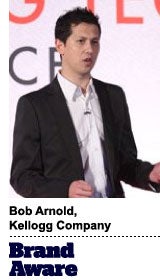
I’m Bob Arnold, Associate Director of Global Digital Strategy at Kellogg Company, and I have the privilege of penning this column. I’ve been in the digital marketing space for more than 12 years – 10 years at Procter & Gamble and two years at Kellogg.

Having grown up in the “branding” side (as opposed to the “direct” side) of marketing, I’ve always felt that ad tech companies – to a certain degree – have ignored or simply not understood brand marketers. This is evidenced by the lack of innovations that are developed with branding as the main focus.

As a result most large brands only invest a fraction of their budget into the space, despite the mass consumer adoption – a recent AdAge article states, “By the most generous estimates, the all-in costs of digital make up around 10% of P&G’s U.S. marketing outlay and a similar share for P&G’s big global rivals, Unilever and L’Oréal — Nos. 2 and 3 in global ad spending, respectively.” It has become a vicious cycle!

My vision for this column is simple – to help close the gap between amazing technology companies and brand marketers. If ad technology companies understand what keep brand marketers up at night, we’ll be flooded with incredible innovations.

Trust me, brand marketers want to play much more in the space, we just need help getting there. So, while I definitely don’t have all of the answers. I’ll do my best to represent what’s on brand marketers’ minds, our needs, frustrations, etc.

Which brings me to you. Whether you are a fellow marketer or in ad tech, I look forward to your feedback, questions, and, above all, your participation. Please post suggestions for future columns in the comments below.

Google has famously predicted that the display market will hit $200B a year. Clearly we have a ways to go and I want us – together – to do everything possible to make it a reality.

Follow Bob Arnold (@bobbyarnold) and AdExchanger (@adexchanger) on Twitter.

Must Read

AdExchanger's Big Story podcast with journalistic insights on advertising, marketing and ad tech

Google Had Its Day In Court. Now, It’s Amazon’s Turn

Google won’t have to break up its ads business after being declared an online monopolist. Meanwhile, Amazon faces a lawsuit from the FTC alleging that it charged advertisers more than necessary for ecommerce ads.

The FTC’s Amazon Lawsuit Is Ad Tech’s History Of Opacity Repeating Itself

Buy-side experts said it’s another example of a Big Tech platform taking advantage of the lack of transparency built into programmatic ad auctions. And they’re not optimistic change is coming.

How The Fin Tech Clearco Finances Ecommerce Startups (Without Losing Its Shirt)

This week, the Commerce Media Newsletter catches up with a startup from outside the world of data-driven advertising, but with an interesting position when it comes to ecommerce advertising. That’s Clearco, a Canadian fin tech company founded in 2015.

Privacy! Commerce! Connected TV! Read all about it. Subscribe to AdExchanger Newsletters
LOS ANGELES, CALIFORNIA - APRIL 26: Halo Collar CMO Seth Solomons attends a Celebration to Shine a Light On Dog Safety With Halo Collar on April 26, 2022 in Los Angeles, California. (Photo by Stefanie Keenan/Getty Images for Halo Collar)

How Halo Collar Uses Data And Incrementality To Raise Both Awareness And Sales

Halo Collar, a dog collar brand with direct-to-consumer origins, is preparing for its retail expansion by honing its first-party data strategy and incrementality measurement.

tech family cartoon technology family

CartographAI Launched To Help Advertisers Pick The Right Tech Vendors. Now, It’s Helping Vendors Market Themselves, Too

The company is launching an accelerator program to help tech vendors pitch their solutions in a way that makes sense to advertisers.

Comic: Weather Bar

Neuroscience And AI Are Transforming The Weather Company’s Measurement Stack

TWC is building a monetization model that treats weather as both a contextual and an emotional signal, and it’s using AI sales agents to bring it to market.



