AUTHOR ARCHIVE FOR:

Anthony Vargas

Anthony Vargas

Senior Editor

Anthony Vargas ( anthony@adexchanger.com ) covers publisher news and sell-side technology, with a particular focus on the rise of alternative datasets to replace those derived from third-party cookies. He also covers the gaming, digital audio and digital out of home markets. His previous B2B publishing experience includes covering the commercial audiovisual and music retail industries. He also has a background in literary publishing.

Articles By Anthony

  • Comic: New Verse Same As The First?

    Citing Ad Revenue Woes, Meta Will Be ‘Same Size Or Slightly Smaller’ By End Of 2023

    Meta reported $27.2 billion in ad revenue in its Q3 earnings report on Wednesday. That represents a 4% drop year-over-year (YoY). Net income for Q3 was $4.4 billion, down 52% YoY. And Meta is projecting another revenue dip for Q4. As a result, the company will implement layoffs and hiring freezes throughout 2023.

  • Jeremy Hlavacek, CCO at Experian

    Experian On Why Signal Loss Isn’t Slowing Down The Demand For Targeting Data

    “The personalized targeting data points we’ve gotten used to are under examination,” said Jeremy Hlavacek, CCO of data services provider Experian. “Advertisers want better identity data, better segments and better understanding of consumer behavior. So they’re going to shift to higher-quality, more precise, more accurate, more trusted data sets.”

  • Bloomberg's Julia Beizer, Blavity's Jeff Nelson and Dotdash Meredith's Daniel Papalia offered insights into their revenue strategies at AdExchanger's Programmatic I/O event in New York City.

    For Publishers, There’s No Cookie-Cutter Approach To Sustainable Revenue

    With a recession looming and even more signal loss on the way, publishers need to experiment to find the best mix of revenue-generating solutions and approaches. Bloomberg’s Julia Beizer, Blavity’s Jeff Nelson and Dotdash Meredith’s Daniel Papalia offered insights into their revenue strategies at AdExchanger’s Programmatic I/O event in New York City.

  • Dan Taylor, VP of global ads at Google, speaks with AdExchanger executive editor Sarah Sluis at Programmatic I/O 2022 in New York City.

    Google Swears It’s Not Bluffing About Quitting Cookies

    Google isn’t bluffing about quitting its third-party cookie habit. That’s because consumer concerns about data privacy and pressure from regulators around the globe have left Google with no choice but to discontinue third-party cookie usage in Chrome, said Dan Taylor, VP of global ads at Google, at AdExchanger Programmatic I/O conference in New York City on Monday.

  • Brian Gleason, CRO at Criteo

    Why Agency Relationships Are At The Heart Of Criteo’s Retail Media Strategy

    Getting cozy with agencies wasn’t always a priority for Criteo, which has direct relationships with more than 20,000 clients. But now that Criteo has commerce and retail media aspirations, it needs to strike agency partnerships, says its CRO Brian Gleason.

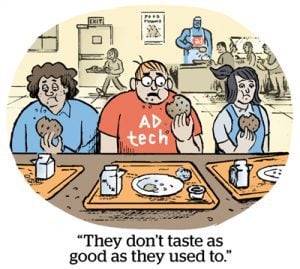
  • Comic: "They don't taste as good as they used to."

    Mercedes-Benz Takes Cookieless Targeting For A Test Drive

    One emerging alternative to the use of third-party cookies is predictive modeling that optimizes targeting using privacy-compliant data signals, such as weather and time of day. Mercedes-Benz recently worked with Merkley + Partners to test this type of cookieless targeting solution against both cookie-based targeting and contextual targeting.

  • "Elvis" director Baz Luhrmann is the credited with the concept behind Bombay Sapphire's "Saw This, Made This" campaign.

    Bombay Sapphire – And Baz Luhrmann – Toast First-Party Data With A New Brand Campaign

    A new campaign from Bombay Sapphire, which launched on Wednesday with spokesperson and “Elvis” director Baz Luhrmann, combines influencer-led social media interactions with the goal of building a loyal customer base that’s (hopefully) willing to share personal information. Bombay Sapphire is looking to generate the kind of lift in brand awareness and affinity that can lead users to intentionally opt into future promotional efforts.

  • How My Code’s Prebid Tech Makes It Possible To Manage Omnichannel Inventory

    My Code, a publisher network that specializes in multicultural media, manages display and video inventory across nearly 800 sites under its umbrella. Because of the complexity of programmatic sales across such a diverse portfolio of sites, including a mix of owned and third-party clients, My Code has relied on PubMatic’s OpenWrap unified bidding solution for the past two years.

  • Invisalign's branded experience inside Roblox's Livetopia.

    When It Comes To Marketing In The Metaverse, Awareness Matters Most

    While brands want to be active in video games, on influencer-driven streaming video platforms like Twitch and in metaverse-like online games like Roblox, it can be hard for marketers to measure ROI in these spaces. However, for Invisalign, like with other early-adopter brands, the opportunity in new gaming and metaverse channels has more to do with driving awareness than increasing incremental sales.

  • Political Advertisers Are Spending More Than Ever, But Not On Local News

    US political ad spending is exploding in the runup to the 2022 midterm elections, with an estimated $8 billion to $13 billion up for grabs this election cycle. But, while CTV and streaming video are seeing an infusion of political ad cash this year, local news publishers aren’t seeing a dramatic change in their bottom lines.

  • Fandom Spies Data Play With Acquisition Of Entertainment Sites

    On Monday, Fandom snapped up GameSpot, Metacritic, TV Guide, GameFAQs, Giant Bomb, Cord Cutters News and Comic Vine from Red Ventures. The acquisition improves Fandom’s reach among fan communities, which will supplement its offering for marketers throughout their journey through the marketing funnel, said Fandom CEO Perkins Miller.

  • Jill Wittkopp, VP of product at the IAB Tech Lab

    Supply Chain Transparency Is Key To Supply Path Optimization

    You can’t have supply path optimization (SPO) without supply chain transparency. The ads.txt version 1.1 update released in April added OWNERDOMAIN and MANAGERDOMAIN variables that allow publishers to label a site’s parent company and the intermediary that is selling a site’s ad inventory. The IAB Tech Lab’s Jill Wittkopp spoke to AdExchanger about how these supply chain transparency tools relate to the industry’s pursuit of SPO.

  • Hamza Kourimate, VP and global head of sales marketing and data solutions at Dailymotion

    Dailymotion Is Putting All Its Eggs Into Contextual

    Forget the post-cookie future. For Dailymotion, user-based targeting is already a thing of the past. Hamza Kourimate, VP and global head of sales marketing and data solutions at Dailymotion, spoke to AdExchanger on how the video platform is using its first-party data trove to build a contextual framework for video.

  • This Travel Publisher’s Investment In Programmatic During The Pandemic Is Now Paying Dividends

    After two years of lost revenues, travel-focused publishers are eager to maximize a post-pandemic recovery. BoardingArea, a publisher network that includes more than 60 travel blogs, isn’t just banking on a return to normal, said its founder Randy Petersen. After weathering the pandemic, BoardingArea is betting on revenue diversification and a revamped programmatic tech stack for its future growth.

  • Karthic Bala, executive vice president of data, product and technology at CNET, a Red Ventures brand

    For CNET’s EVP Of Data, Protecting Privacy Is More Important Than Monetization

    First-party data will be indispensable in a world without third-party-cookies. But before publishers can monetize that data, they need to respect it, said Karthic Bala, executive vice president of data, product and technology at CNET, a Red Ventures-owned publisher that covers tech and consumer electronics.

  • Ecommerce Has Slowed, But Retail Media Is Outpacing Digital Advertising

    Ecommerce momentum has tailed off since last year, but global ecommerce and retail media still have plenty of room for growth, according to GroupM’s 2022 Ecommerce and Retail Media Forecast. Total global retail media spend will hit $160 billion by 2027, which represents a 60% growth rate over five years, GroupM predicts.

  • What Does “Premium” Mean, Anyway?

    What exactly does “premium” mean? It seems the definition varies depending on who’s using it – that “premium” is in the eye of the beholder. But there are some areas of agreement. And the industry isn’t setting the premium bar as high as you might think.

  • Comic: New Verse Same As The First?

    Metaverse Marketing Gets A Reality Check At IAB Audience Connect

    For the most part, metaverse early adopters say they’re just exploring the possibilities rather than trying to really demonstrate ROI. And while hugely popular online games like Roblox and Fortnite are lumped in with metaverse platforms, they’re really Web 2.0 gaming without the decentralized interoperability promised by Web 3.0 and blockchain technology. The few actual metaverse environments in market, such as Decentraland and The Sandbox, don’t offer the audience reach advertisers crave.

  • Advertising Is The Next Man Up For The Athletic As The NYT Plays For Profitability

    New York Times-owned sports publisher The Athletic introduced display ads on its site and in its app on Monday – but don’t expect to be able to buy these ads on the open web. The goal is to make The Athletic profitable within three years.

  • Zynga Buys ASO Platform Storemaven To Cut Down On CAC

    Mobile game developer Zynga closed its acquisition of ASO provider Storemaven on Monday. Zynga, which declined to share the terms of the deal, is acquiring all of Storemaven’s IP and technology, and it will add Storemaven’s staff of 50 to its current headcount of 2,900. Storemaven founder and CEO Gad Maor will continue to lead the Storemaven team.

  • Brendan Spain, VP of Advertising, Americas at the Financial Times.

    Why The FT Says Open Web Programmatic Isn't Worth Its Attention

    The Financial Times has long avoided chasing open web programmatic ad revenue. Now, with signal loss prompting a renaissance for contextual targeting and direct deals – and with momentum behind attention metrics, of which the FT was an early proponent going back to 2015 – the publisher’s longtime strategy seems prescient. Brendan Spain, the FT’s VP of advertising for the Americas, spoke with AdExchanger.

  • Why A Recession Won’t Change What Matters To Marketers

    For much of 2022, business leaders have been bracing for a downturn. But if a recession does hit, advertisers are unlikely to pull back on performance spend as they continue to chase consumer attention amid changing media consumption habits.

  • How One Of The Little Guys In Digital Media Figured Out Programmatic

    Chrome Unboxed, which started in 2015 as a YouTube channel for unboxing videos featuring Google’s Chromebook products, is emblematic of the early struggles upstart publishers have in monetizing their content. Its path to ad-supported profitability shows there’s still hope for the little guys in digital media.

  • For Bosch’s New Campaign, Linear TV Isn’t In The Toolbox

    For Bosch Power Tools’ new “What Hard Workers Deserve” ad campaign, the company had to weigh the best channels to convey its message in the face of changing consumer behavior. And for this campaign, the company decided to steer clear of linear TV.

  • Brand Lift Matters, Even For PepsiCo

    Brand awareness is top of mind for PepsiCo’s senior director of media strategy and investment Katie Haniffy. And PepsiCo is focused on adjusting its brand awareness campaigns in response to shifting consumer behavior, as well as pivoting to keep up with the latest evolutions in ad tech.

  • Bill Drolet, Enthusiast Gaming CRO

    Marketers Don’t Get Gaming, And Enthusiast Wants To Help

    For Enthusiast Gaming, a publisher that specializes in ad-supported gaming content and game development, macroeconomic trends have contributed to a perfect storm. But Enthusiast is looking at the bright side, as advertiser interest in game-related properties is on the rise. Enthusiast CRO Bill Drolet talked to AdExchanger about gaming’s cross-platform value proposition, plans for continued direct sales growth, early forays into in-game advertising and more.

  • eyes on stalks

    AdExplainer: How To Use Attention Metrics

    Rather than looking at one particular data signal, attention metrics include a variety of data points, which are fed into a machine-learning model to predict the likelihood that a given media environment and ad creative will draw attention from a hypothetical audience member.

  • IBM Sets Its Sights On Cookieless Retargeting

    When people decline tracking cookies or use already-cookieless browsers, such as Safari and Firefox, it can prevent brands from reaching potential customers who may be interested in seeing their ads. In an effort to tackle this addressability challenge, IBM recently ran a test campaign focused on retargeting B2B prospects across Safari and iOS in partnership with MediaMath and alternative identity provider ID5. IBM and MediaMath are longtime partners, but this test was the first time IBM worked with ID5.

  • Buyers Are Dragging Their Heels On Seller-Defined Audiences Over A Lack Of Transparency

    Many publishers are betting big on seller-defined audiences (SDA) as a centerpiece of their post-third-party-cookie monetization plans. Problem is, although publishers are eager to test the performance of SDAs, there’s still very little demand from the buy side. AdExchanger spoke with ad agencies and buy-side tech platforms to get their side of the story.

  • Monetization Startup ArcSpan Has A New Tool To Help Publishers Use Contextual Taxonomies

    A lot of ink has been spilled about the value of a publisher’s first-party data, but publishers can’t effectively monetize their data programmatically if they don’t have a standardized way to categorize it. On Monday, ArcSpan released Contextual APP, a data processing tool that enables publishers to structure their first-party contextual data into salable audience segments, including seller-defined audiences, using the IAB Tech Lab’s content and audience taxonomies.

1 5 6 7 8 9 10 11 12 13 14 15 16