

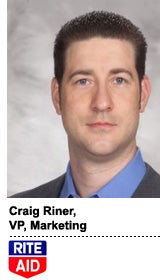
 When Rite Aid launched its wellness+ program in 2010, it didn’t want to create just another plastic rewards program.
“We really wanted it to be a brand awareness and loyalty initiative, since we were the first in retail to not only offer savings and discounts, but also to offer health and wellness benefits as part of our program, which was a big point of differentiation for us,” said Craig Riner, VP of marketing for Rite Aid.
Today, wellness+ has 25 million active users, and Rite Aid is the first pharmacy to join a new American Express-backed cobranded loyalty coalition, Plenti, where members redeem points across partner brands like Hulu, Macy’s and AT&T.
Rite Aid will benefit from anonymized data insights from partner merchants as a result of joining the coalition and is looking to leverage its loyalty asset for new customer acquisition and monetization online, through mobile and across its 4,600 brick-and-mortar stores.
Riner spoke with AdExchanger.
AdExchanger: What benefits does a loyalty coalition give marketers?
CRAIG RINER: There are three key prongs for our involvement in the Plenti program and the first is a more meaningful rewards structure for our lesser engaged customer. Second is acquisition of new customers from other partners as well as customers who may not have been loyalty members at all but who, because of the collective marketing efforts of all the members, are now taking advantage of it. The third is the insights and the data sharing.

What data do you have access to?
Transaction data is all anonymized, and whatever we share with American Express and US Loyalty’s operating division, nothing gets shared with other partners at the individual level. We have, as part of the US Loyalty coalition operation, a dedicated analytical resource that will be churning through all the data collectively and helping us come up with data-informed targeting approaches.
What kinds of insights?
[For instance] there may be interesting nuances where customers who buy premium fuel at Exxon will be more prone to purchase this pharmacy drug, or customers who buy handbags at Macy’s are great candidates for cosmetics at Rite Aid because we see a lot of cosmetics purchases. We can do a lot of lookalike modeling and targeting and discovering in aggregate, what our customers do beyond our walls. It’s going to be very interesting in terms of the relevancy and offers we’ll be able to give to consumers.
Beyond new customer acquisition, are you expecting to increase the lifetime value of existing loyalty members?
On the pharmacy side, it’s hard to grow prescriptions from an existing customer from a loyalty perspective. You either need prescriptions or you don’t need prescriptions. The one way we have seen growth is through consolidation. A very large percentage of customers split their prescriptions amongst multiple pharmacies and that may be out of convenience if one location is close to work or to home.
On the front-end, non-prescription side of the business, we’ve absolutely seen our loyalty members whose transactions are higher than the actual average basket size of non-members, and those dollars increase as people move from bronze to silver to gold. We see lift when they move from one tier to the next, and while we give up some margin because we give them a deeper everyday discount – 10% at silver and 20% at gold – we see them spend more and their overall value to us is much greater.
So loyalty tiers have helped you anticipate propensity to purchase?
At the very highest tier, our gold and silver members are very engaged and our spend is growing with them year over year. But for the lesser engaged customers, those at the bronze tier, this [Plenti program] might give them a more meaningful reason to engage with our brand because they can earn points for savings at partners that might be more meaningful to their lifestyles, be it cell phones, fuel, department stores.
For us, it was a way to activate the lower and less engaged customers and drive new customer acquisition for brand loyalists for other partners, and encourage them to turn left into our stores instead of right into CVS or Walgreens because they have points they can redeem at a partner location.
AmEx is investing heavily in TV to promote Plenti. How are you prioritizing what dollars you’re putting toward Rite Aid’s participation?
One of the benefits of the coalition is the collective marketing spend from all the marketing partners. We spend a lot of time with the other partners and with American Express coordinating our activities, to make sure weren’t bidding against each other for search terms or for pod placements for television. It was a first of its kind. The size of the brands and collective marketing we do, the planners and buyers and agencies for each of these brands had to all coordinate as we went to market.
I give American Express a lot of credit for maintaining the consistent brand voice of Plenti, while still having the brand personality for each of the partners as well. We want all 25 million members to know: What you love hasn’t gone away, it’s just better and you have more value. We wanted to illustrate that especially in our TV campaign, the concept of earning in one place and using in another.
Did your agency of record execute that TV plan or do you rely on a multitude of agencies for channel executions?
MARC USA is our agency of record but we have a number of promotional agencies or digital agencies we work with as well. As there are more channels and areas of specialty and marketing becomes more reliant on technology, there are so many smaller boutique firms and tech startups you can’t ignore. No one agency or retailer can be a master of all of them. Our agency of record understands the voice, the tone, and where we’re going strategically as a company. But there’s room for others to help deliver unique, specialized experiences across individual channels.









