Before Tinder, Plenty of Fish and OKCupid – even before the advent of the mobile ecosystem – there was eHarmony. Since 2000, the dating site has tried to help the world’s lonely hearts find their one true love.
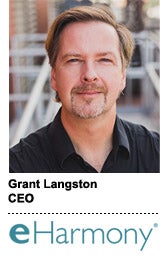
Grant Langston, appointed CEO about a year ago, has been with the company since the beginning.
Langston’s long-term relationship with eHarmony began in the marketing department. He spent the first decade of the 21st century working on eHarmony’s content marketing, then moved to social media and brand marketing.
But jumping into the CEO role was an eye-opener, as Langston became suddenly aware of many of the company’s facets that, as a marketer, he didn’t even know about.
EHarmony revealed a new logo a few weeks ago, but deeper changes are happening at the organizational level.
Though still in its very early days, Langston spoke with AdExchanger about that transformation, and marketing’s role within it.
AdExchanger: You began your career as a marketer, first as a writer, then moving up the ranks. Now you’re CEO. What’s that transition been like?
GRANT LANGSTON: I spend a lot of my time in conversations where I’m the least informed person in the meeting. As CEO, I’m talking about technology or health insurance – things that aren’t my specialty. But marketing is a place I feel at home.
What’s been the biggest surprise as you moved from marketing to CEO?
Anytime you’re very narrowly cast in a business, your perspective is also narrow. For the last five years at eHarmony, I’ve known every single part of our marketing effort – the spend, the costs – but I’ve known nothing about the rest of our business. I’ve been two inches deep into tech, into finance, into legal.
In my role now, I’ve had quite an education about the other parts of our business. And the biggest surprise is how this works well together and how it affects each other in profound ways.
There was a siloed mentality where each group has a set of numbers and isn’t interested in what the rest of the group is doing, and at the end of the day, we need to be more involved with the other parts of the business.

How do you change that?
We just really began, and it’s not something that happens overnight. We’ve started by realigning the groups. If you think about our customer care team that’s deeply involved with our users every day, it’s a real retention effort. Now we’re connecting customer care to product in a way they’ve never been connected.
Why now?
The executive team and I felt that this is something we desperately need. We had a culture of putting in the effort, but not tied to accountability.
When you were in brand marketing, did you realize this?
I didn’t know this problem existed. I’ve been here a long time, and I had a lot of cross-organizational contacts and, if I needed something, I could get it. But you find, when your purview extends, that things are happening that you weren’t aware of.
How does this affect marketing?
At some level, marketing makes promises the product must keep. We gauge our results in marketing based on response rates. If you’re talking about digital marketing, you’re looking at the ROI you’re spending or the traffic numbers on the site. That’s how I saw the results.
We’d do a campaign of some kind, and I’d see a lot of success from my chair. But downstream, in customer service, people were being brought into the product with a lot of expectation. They were thinking, “Wow, this is like a machine. I put a nickel in it and a person rolls out!”
I was disconnected from the dissatisfaction I might be making by painting a picture that was too rosy.
Will your organizational transformation require new tech?
I don’t think we need any new systems. We’re installing this as a cultural idea, and we’re going to live with it until the end of the year. Then we’ll pause and see what happens. Where were the shortcomings, where did it work, how does it need to morph? Are there tools we need to help the staff with it?
In my life and business, almost everything I do, the first try isn’t great. And you have to be patient and learn your lessons. Then you can modify.
Do you use an agency?
We have a creative agency, a TV-buying agency and a couple of radio agencies. They wouldn’t be effected by a reorg. They’re super important to our work here. TV buying, for example, is something that you really need an agency for. We have DirectAvenue, which is our partner and we couldn’t live without them.
How about digital media?
We do that ourselves. We have a lot of vendors who do various programs for us, folks like Commission Junction and many others. But we don’t have an overarching digital agency to handle that.
Why not?
We haven’t felt the need. Digital marketing is something that has been a winning area for eHarmony for a long time. We’ve never had a digital agency, and it’s something where we have a lot of internal knowledge.
If someone came in and said, “We can drastically improve your results,” I’m all ears. But the internal team is driving the results we want. It’s about eight people who do US and Canada. We have about seven people in Sydney and six people in London.
If you were to go back in time and advise Grant Langston the marketer, what would you tell him to do less of, and what would you tell him to do more of?
I’d tell Grant to keep the focus on the mission of the company. So much of today’s marketing misses out on the narrative of why you should use a certain business.
On the other side of the fence, I’d open myself up more to the rest of the organization. People who are interested in one area, who are good in one area and are not so social just come in and do their work.
But it’s easy to say to someone, “Hey, do you want to get a hamburger?” And at the end of that lunch, you’ve made an ally and you’ve shared your perspectives. So never have lunch by yourself.