Here’s today’s AdExchanger.com news round-up… Want it by email? Sign up here.
Disney’s Carriage Ride
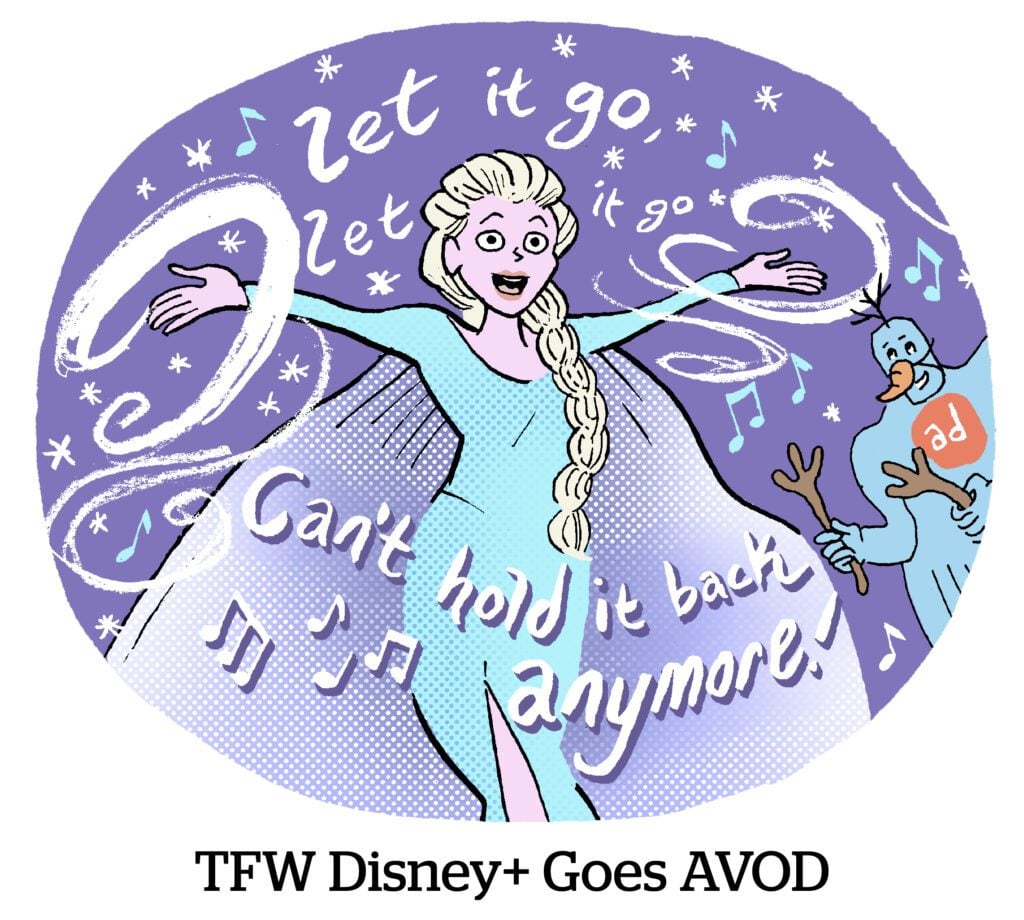
Disney and Charter resolved their cable carriage dispute on Monday, re-upping Disney-owned networks (namely, ESPN) to Charter’s 15 million subscribers.
As part of the deal, Charter’s most popular cable package will include access to the ad-supported tiers of Disney+ and ESPN+, according to The Wall Street Journal.
This move is a big deal because it establishes a precedent for cable operators to demand entertainment giants open up their streaming services. And it potentially leads to higher subscriber counts for ad-supported streaming.

Streaming services can also offer superior experiences that would otherwise entice customers to cut the cord. Take the recent US Open tennis tournament, broadcast by ESPN. ESPN+ subscribers could follow play on any court, whereas the linear network feed is bound to one game.
Since Disney and ESPN are making their AVOD services more compelling than regular TV, the Charters of the world aren’t satisfied with offering customers a single feed anymore.
Putting Up A Front
Advertisers had the upper hand during this year’s upfronts.
Prices were down roughly 5% from last year, buyers tell Adweek. And some streaming services (cough, Netflix) dropped prices even more compared with the CPMs they charged after first launching ads.
Economic concerns made advertisers much more money-conscious, so programmers had to compete for smaller budgets by giving advertisers more flexibility, including letting advertisers take their time to finalize their commitments. That would explain why negotiations lasted longer this year than they typically do.
Speaking of financial wariness, advertisers stuck to using the Nielsen panels they know and (don’t really) love to negotiate their deals, which featured streaming and sports.
Alternative TV currencies were a “nothing burger” this year, says one buyer.
If the economy shapes up enough, advertisers might feel more adventurous with Nielsen competitors next year. But it’s uncertain whether they’ll be willing to fork over the same amount of primetime dollars as yesteryear.
“If people can find other places where their dollars work [at a lower] cost,” one buyer says, “they won’t go back.”
Happiness Not Guaranteed
Many social advertisers are taking a hard look at their performance agencies. Or at least they should be.
Alex Greifeld, a marketing consultant who writes the No Best Practices newsletter, has some tips for vetting the promises of growth marketing.
For one thing, brands should familiarize themselves with Meta’s ad products and figure out if their business is even a fit for the platform. Not all brands are built to turn a profit on Facebook or Instagram. Marketers should have a list of high-level goals and KPIs for paid media to achieve over the next three years. They should also invest in a library of high-quality creative assets and update their creative options regularly. Many media agencies don’t provide creative services, such as raw photo and video content; they can just advise on what they think will work.
Small or bootstrapped brands should choose an agency that fits where they are in the maturity cycle. And, above all, brands should do their due diligence, like asking for referrals and vetting agencies for more than price.
But Wait, There’s More!
Hearst pulls 37 local channels from Dish in a carriage dispute. [New York Post]
The NFL says DirecTV is misleading viewers about where to watch its Sunday Ticket games (which are on YouTube TV). [Ad Age]
Google will mandate AI-generated content disclosures for political ads starting in November. [Marketing Brew]
Instacart sets expectations for its IPO. [Bloomberg]
Meta unveils plans for its next AI model. [WSJ]
Why it might be time for MySpace to make a comeback. [Mashable]