Here’s today’s AdExchanger.com news round-up… Want it by email? Sign up here.
Shape Up Or Shop Out
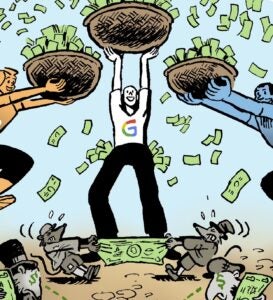
Parallel news items reinforce the massive relative advantage for Amazon and its ad business compared with Facebook and Shopify in the wake of Apple’s data privacy overhaul.
For years, rumors flew that Facebook was angling to acquire Shopify, The Information reports. But the two companies are now butting heads because Shopify won’t nudge its merchants to share customer data between the two platforms. Hundreds of thousands (if not millions) of Shopify merchants have Facebook business accounts that connect freely and easily to their Shopify accounts.
Shopify’s integrations with Facebook and Instagram could be a lifeline for Meta as it attempts to access the data it previously had to track prospects and optimize campaigns based on purchases. But Shopify isn’t willing to push its merchants to opt in, at least not as aggressively as Meta would like.
Amazon, meanwhile, announced a product called “Buy with Prime” for merchants and publishers to sell items covered by Prime shipping from their own sites. It uses Amazon Pay (so Amazon still owns the purchase data) and Amazon fulfillment. It’s also an Amazon Prime sign-up vehicle, because users must be Prime members even though the purchase is being made off of Amazon.

Xandr’s Data Partner Party
Data analytics platform Xandr (soon to be a Microsoft Advertising point solution, if the acquisition clears antitrust approval) announced plans to work with a slew of TV measurement providers, including VideoAmp, Comscore, Samba TV, EDO, TVision and 605.
Television ad measurement is in the midst of dramatic change in large part thanks to the growth of CTV. But it’s data-driven linear that Xandr has on its mind.
Linear TV buys are primarily transacted based on traditional audience demos, such as women between the ages of 25 and 45.
But there has been a “move over the last few years [toward] the use of data to inform linear buys,” Mark Mitchell, Xandr’s VP of business development, tells AdExchanger. “Audience-based targeting probably still represents a small percentage of total linear ad spend – but that [ratio] is growing every year.”
Xandr knows buyers need cross-screen targeting, too, which is why Mitchell says tacking on CTV and OTT capabilities will be what the company focuses on next.
Nonetheless, Xandr swears neutrality in the alternate TV currency wars.
Agencies and programmers are floundering for “one or two different horses to work with,” Mitchell says. “But we don’t want a stake in that game at all. We want our position in the marketplace to be agnostic to the data sets customers want to use.”
The Work-Life Imbalance
Vendor-commissioned surveys usually tell you more about the vendor than whatever the survey is looking into.
And that’s certainly the case with a Forrester study sponsored by Microsoft Advertising and published yesterday that chronicles the rise of the “Workday Consumer.”
When people’s workdays moved online or to hybrid setups in 2020, it didn’t just mean more virtual meetings.
“Shopping and services did too,” according to the Microsoft Advertising blog. “Groceries and cars were being delivered, exercises and meditation classes were held on demand and digital happy hours came and went.”
Microsoft’s point is that the to-do lists that dominate our home lives – which is to say, groceries, home supplies and planning trips – have merged into people’s workday list of tasks. And so, when people are on a break at work, it could be a unique opportunity to prompt them to take a trip to the grocery store or make an online purchase.
Makes sense … but why does Microsoft care?
Who’da thunk it, but turns out Microsoft is the world’s largest purveyor of workday employee software and knows keenly how and when people are working (or not-so-much working) remotely.
But Wait, There’s More!
Inside the relaunch of The Economist’s subscription mobile app. [Digiday]
Companies lose your data, then nothing happens. Should we toughen data breach consequences? [Vox]
CNN+ is shutting down … after less than a month on the market. [Variety]
Stagwell acquires the Polish ecommerce agency Brand New Galaxy. [MediaPost]
Dept doubles down on its US agency presence with its acquisition of 3Q Digital. [The Drum]
Netflix Animation erased: Creators migrated to Netflix because of unprecedented creative freedom. Now they’re facing a very different reality. [The Wrap]
You’re Hired!
Postclick promotes Hunter Sunrise to SVP and head of marketing. [release]
Sharethrough brings on Ben Skinazi as its first CMO. [release]