Here’s today’s AdExchanger.com news round-up… Want it by email? Sign up here.
Up Anchor
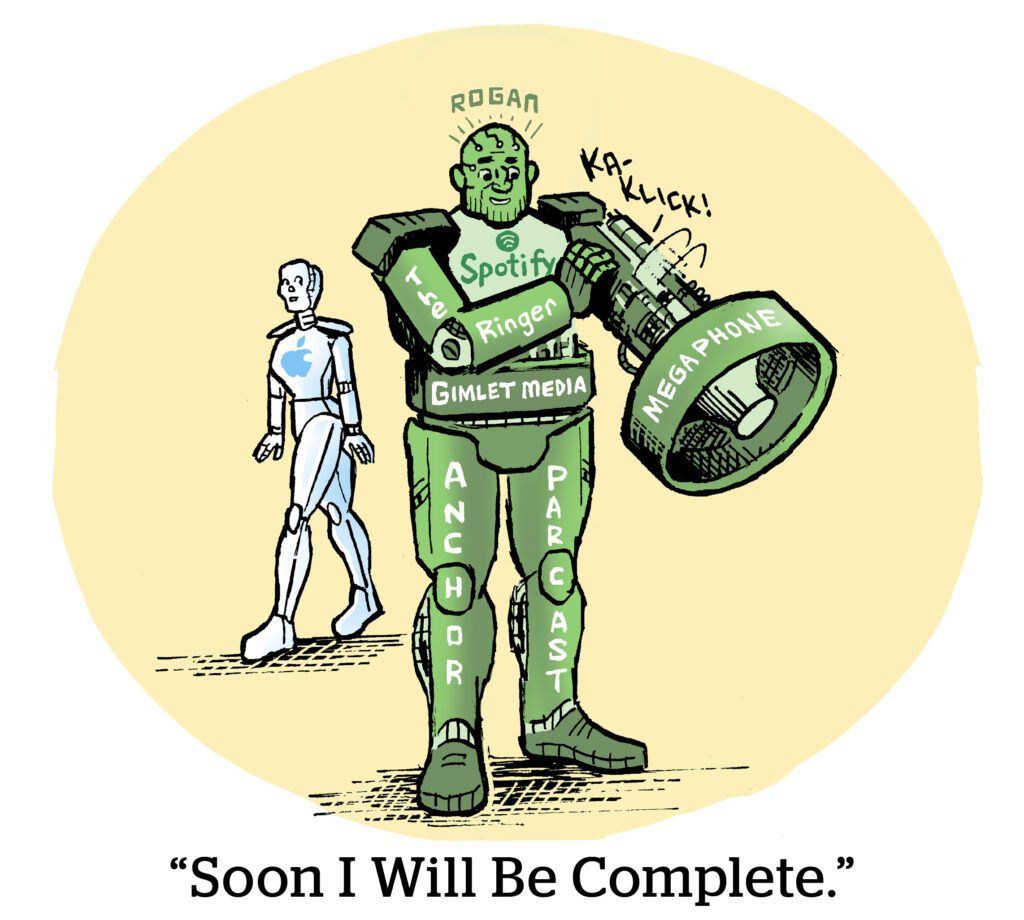
Podcast advertising is in growth-stage purgatory. Consumption numbers are on the up-and-up … but monetization hasn’t followed.
Most podcasts were originally distributed across platforms in a centralized way, so there was a strong proposition for ad tech that could serve campaigns across multiple listening touch points.
But that’s changing with Spotify, which makes its podcasts exclusive.
There is a legit need for walled-garden-type platforms, like Spotify, to take over podcast monetization, according to a Stratechery Q&A with Michael Mignano, who has a unique perspective since he co-founded and led Anchor, a podcast advertising and audience platform that was acquired by Spotify in 2019. Mignano led Spotify’s podcasting, live talk and video products until he left in June.
Back when podcasts were powered by RSS (open web feeds that any listening platform can plug into), there was little to no listener-level data available. Impressions couldn’t be targeted to individuals, only to a program.
“There’s tons more potential now,” Mignano says, “but the fact that there’s effectively no data for advertising through RSS has constrained the market.”

Google Play Pays
Google is piloting a program that lets Google Play Store app developers use their own billing systems starting with Australia and parts of Europe and Asia.
Although Google didn’t disclose the fee structure for its pilot, this is an expansion of a program it launched in July that cut transaction processing fees from 15% to 12% for developers in the EU, TechCrunch reports.
Google started ceding Google Play territory in the EU immediately after the EU Parliament passed the Digital Markets Act to curb the anticompetitive business practices of large tech platforms. Google has also been pressured to reduce its developer fees in South Korea, Japan and the Netherlands.
But despite just having settled a $90 million suit with US developers earlier this summer, Google’s new billing program doesn’t include US markets.
So, what about the US? There’s proposed legislation wending its way through Congress that’s similar to the Digital Markets Act called the Open App Markets Act, but it’s only a bill.
The US government still can’t agree on how to regulate Big Tech platforms at the federal level, and Apple is vehemently rallying against the Open App Markets Act, citing data privacy concerns.
Guilty By Association
Kochava CEO Charles Manning published an open letter about the company’s back-and-forth suits with the FTC. (TL;DR: In August, Kochava was alerted that it would be sued by the FTC for alleged privacy violations. Kochava filed a preemptive suit against the FTC calling the latter’s proposed suit wrongful. And then the FTC brought its case this week. A pretty little mess.)
Manning writes that the FTC’s case “is entirely based on hypothetical scenarios, there are no references to any actual instances where Kochava sold data to reveal visits to sensitive locations – certainly not sensitive health locations like women’s health clinics.” He also says that “the FTC cannot point to specific instances because it simply doesn’t happen.”
And it is true that the case doesn’t highlight a specific infraction by Kochava so much as it attacks the entire business of selling location data programmatically.
Even so, to argue that the FTC can’t share specific examples somewhat misses the point. Privacy advocates and regulators are as concerned with the hypotheticals and edge cases as they are with specific offenses.
The Dobbs Supreme Court decision to overturn national abortion rights isn’t cited by the FTC in its complaint, but the sun setting on Roe v. Wade no doubt inspired the urgency to establish precedent. We now live in a world where companies can collect and resell theoretically incriminating data on women or healthcare workers.
But Wait, There’s More!
How the New Balance brand reinvented itself. [Complex]
Dentsu International Global CEO Wendy Clark resigns. [Ad Age]
Warner Bros. Discovery is losing execs, too. [Deadline]
What Shopify and Snap have in common. [The Information]
How esports grew up: An oral history. [Digiday]
You’re Hired!
Paramount vet Sean Moran joins product placement company Ryff as executive chairman. [Adweek]