Recent: Buy Side On The Auction, Facebook Ad Network, Katz: Marketer Outcomes

The ‘The State Of’ Category

State Of HubSpot: CEO Halligan Eyes The Marketing OS With His Company’s Platform

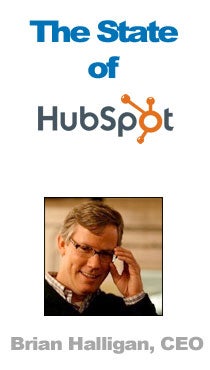
HubSpotBrian Halligan is CEO of HubSpot, a marketing software company.

His company has grown from generating leads exclusively for small business to embracing the same opportunity for mid-size companies. Halligan discussed his company's quest to create a marketing OS as well as recent company developments with AdExchanger.

Click below or scroll for more:

AdExchanger: In your 2009 interview with AdExchanger, HubSpot was positioned around the SMB and social marketing. How has your company’s positioning evolved?

BH: There have been a couple things that have evolved for HubSpot over time. When we first came into the market, we were focused on small businesses. We called the persona "Owner Ollie." He runs a small company, does a little marketing himself on the side. Typically it's a business with 20 or less employees. Over time, we were selling to Owner Ollie, but we've moved up a bit. There's another persona we've developed called "Mary Marketer." Mary Marketer runs a marketing department in a mid‑sized company between 20 employees and 1,000 employees. When we spoke a few years ago, we maybe had 80 percent of our business in Owner Ollie, and 20 percent in Mary Marketer. Today I would probably say it's 80 percent in Mary, 20 percent in Ollie.

Do you describe what HubSpot does as marketing automation?

A couple of thoughts on that. My first thought is that the last thing companies should do today is automate their marketing. There's been a big change in the way we all live, shop, learn and spend our daily lives. I think about my dad, and the way he lived, shopped and learned. He had six TV stations, and two newspapers, and a bunch of mail and phone calls. Then I think of myself, and I have six thousand TV stations, a people I follow on Twitter, a lot of people on Facebook - just a radical, radical change in the way I consume information and learn.

Read the rest of this entry »

State Of Undertone: CEO Cassidy Discusses Serving The Agency And His Company’s Strategic Shift

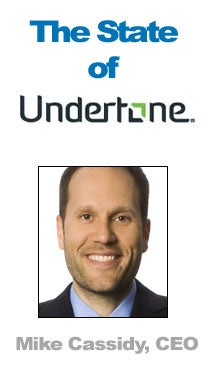
State of UndertoneMike Cassidy is CEO of Undertone, an advertising technology and services company.

Cassidy recently spoke to AdExchanger about his company and industry trends.

Click below or scroll for more:

AdExchanger.com: People think of Undertone as an ad network. Do you?

MC: I used to, but no longer.

When you ask people in the market, especially agencies or publishers, to define an ad network, I typically hear things like, "Low quality inventory, banner ads, below-the-fold ads, lack of ethics," etc.  You'll hear things about data and targeting, too –some of it is good. And, you'll hear about scale and optimization. But when you look at the definition of an ad network, and then what Undertone does, there's a clear difference.

We've had many clients tell us that they work with Undertone because we’ve built out a portfolio of publishers, which is not through exchanges, portals, and through buying ads from other people. They're hand‑selected. They're curated.

And, [agencies use our] proprietary tools and third-party research, which helps them leverage their own capabilities. We’re innovating with products and doing a lot around data, and targeting, too. We think about it not just from our standpoint, but a brand standpoint, and how can you take a science and apply it to the art.

When I look at all of those things, our business is evolving, and the network definition feels limiting.

Read the rest of this entry »

State Of BlueKai: CEO Tawakol On DMP And Exchange Strategies, Data Disruption, More

State of BlueKaiOmar Tawakol is CEO of BlueKai, an ad technology company.

As part of its "State of..." series of articles with industry executives, AdExchanger.com spoke with Tawakol late last month to discuss his company, his views on the space, and the state of BlueKai today.

Click below or scroll for more:

AdExchanger: What are some of the differences between the BlueKai of today and a year ago?

OT: So, early on in our evolution as a business, we were helping the media ecosystem get access to good data so that they could start doing audience targeting. It was all about access to data assets that they didn't have before. Over the last year, what we've noticed is that people have become more mature. They started getting access to different data assets and the focus shifted towards, "Give me a platform that would allow me to create my own proprietary advantage. Let me get my own first‑party data, figure it out, layer on external assets I don't have, and then make it incredibly useful ‑ drive ROI, make it actionable, integrate it in every platform I need to execute on."

So that's the major shift. The data buyers expanded their scope - from testing and experimenting to, "How do I now create a proprietary advantage?" And the answer has been, "I need my own DMP."

And where has this left the exchange strategy which I think BlueKai was initially known for?

It’s been very interesting. What we've noticed is that people who have DMPs end up buying more data. So it's very helpful to the exchange business. However, we run the two businesses entirely separately ‑‑ meaning, if you buy our DMP, you don't have to buy a single bit of data from us. And anything that goes in your DMP stays in the DMP, meaning it's only one‑way access. Data from the exchange makes it into the DMP. Data from the DMP never touches the exchange. They're run, sold and priced separately. The digital data rights and contracts are separate.

I would almost think of this as similar to Android. Android has an app store, and many more people want [to work with] the Android platform than Blackberry. It’s an open platform. Platform marketplace combo business models are very powerful.

Read the rest of this entry »

State Of DoubleVerify: CEO Netzer On Ad Verification Today; Pre-Bid Integration And Momentum

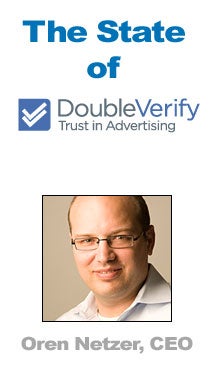
State of DoubleVerifyOren Netzer is CEO of DoubleVerify, an ad verification company.

As part of its "State of..." series of articles with industry executives, AdExchanger.com spoke with Netzer last month to discuss his company, his views on the space, and the state of DoubleVerify today.

Click below or scroll for more:

AdExchanger: Do you think of yourselves as an ad verification company today?

ON: We've been expanding in a lot of different directions and some things have moved into the market already. We see ourselves as much more than just ad verification and think we'll have an opportunity to play a prominent role on the buy side -and we’re evolving into more measurement. There's beginning to be a separation between the delivery layer, the ad server layer and the measurement layer [whereas] they used to be one thing.

Now that the IAB ad verification guidelines have been completed, companies, including ourselves, are in the process of getting accredited by the Media Ratings Council (MRC). What many in the industry are waiting for is that acceptance of verification - MRC accredited - as the new measurement standard for their campaigns. This will begin the evolution of verification to measurement. Already, verification numbers are becoming the standard for campaign billing and it is in a position to do more.

Regarding the measurement side, we've been beta testing with clients for the past few weeks on engagement and viewability. We have had some key clients running in beta for the last few weeks and it’s going to be rolled out soon - all through that one, same tag that we have.

Read the rest of this entry »

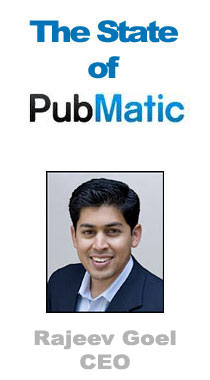
State Of PubMatic: CEO Goel On Apps, Impact of Google-Admeld And Milestones Ahead

State of PubMaticCEO Rajeev Goel is CEO of PubMatic, a sell-side platform.

As part of its "State of..." series of articles with industry executives, AdExchanger.com spoke with Goel to discuss his company, his views on the space, and the state of PubMatic today.

Click below or scroll for more:

What effect has Google’s acquisition of Admeld had on the marketplace and PubMatic?

First, clearly the media and technology market is consolidating and a number of big deals have happened - Admeld as you mentioned, but also deals for companies such as Efficient Frontier, Auditude and Amobee most recently.

We see our role within that as being a platform for consolidation ourselves and simplifying the lives of publishers by bringing them multiple solutions, whether they're developed in-house or through a third party, across our platform for publishers. More specifically, in terms of what we are seeing since the Google and Admeld transaction, the fact that we are both open and neutral is leading us to take share because publishers see us as the independent leader and alternative to a Google-only strategy.

I think that stems from a couple of things. One is we're fully aligned with the interests of the publishers. We have no competing business. We have no conflicts of interest, and obviously, it's an interdependent ecosystem. We try to work with everyone and we work with Google within that ecosystem. We've had three record quarters in a row from a growth perspective - and within that sequential quarter on quarter growth.

Read the rest of this entry »

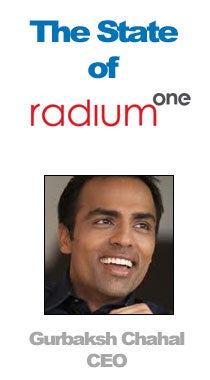
The State Of RadiumOne: CEO Chahal Says Company Building Signal, Targeting Social Ads On Open Web

State of RadiumOneGurbaksh Chahal is CEO of RadiumOne, an online advertising technology company with a real-time social ad platform.

As part of its "State of..." series of articles with industry executives, AdExchanger.com spoke with Chahal to discuss his company, his views on the space, and the state of RadiumOne today.

Click below and scroll for more:

AdExchanger: Regarding the TechCrunch rumor about the valuation of RadiumOne ($500 million) and that you’re raising a round of investment. Anything you can share? Were those numbers correct?

GC: When it comes to things like that, time will dictate the outcomes. We don't have an official statement right now. We are of interest to a lot of people who think that we're doing something interesting. And things like this happen all the time.

Let’s talk about the strategy around the products that you've created thus far and how they relate to ads?

Sure. We launched in October of 2010 with the initiative of social retargeting and had a typical ad network strategy, which leveraged other people's data. Then, we asked how can we control and generate it for our own product. So, the first part of business was called ShareGraph, which was sharing activity on a third‑party basis that we can anonymize - and figure out who's sharing with whom, and make those connections. That was the proprietary technology that started the business.

Then, we looked at going ahead and generating this data on our own. The first product that we launched to focus on that was po.st, which was similar to ShareThis and Add This, but it allows publishers to generate revenue from the sharing activity that's going on on their websites. In turn, it gives us direct first‑party relationship data with the publisher. And that's grown tremendously - faster than I even expected.

And a sub-product of po.st was re.po.st, which is similar to Bit.ly in that you can shorten the length of a URL, but as soon as you shorten the length, it creates an audience segment for an advertiser.

The last piece that we just rolled out is via.me, which we think reflects what’s happening with the digital landscape today. Since 2007, nothing has evolved with retargeting and audience buying except the power went from the ad networks to the DSP (demand-side platform). And the DSP's sole business has been, "How do I become a cheaper way to do the same thing?"

Read the rest of this entry »

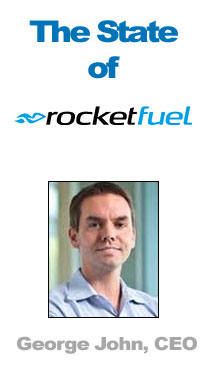
The State Of Rocket Fuel: CEO John Sees Impressive, Real-Time Bidding Impact

State of Rocket FuelGeorge John is CEO of Rocket Fuel, an online advertising technology company.

As part of its "State of..." series of articles with industry executives, AdExchanger.com spoke with John to discuss his company, his views on the space, and the state of Rocket Fuel today.

Click below or scroll down for more:

AdExchanger: Are you seeing the impact you originally anticipated with real-time bidding (RTB) for PC‑based display?

GJ: It’s much better than I thought. If you consider the layers of sophistication around leveraging exchanges and liquid inventory, where "1.0" was the original Right Media Exchange, and you'd log in and define your targeting rules and your bids, then "2.0" was real-time bidding - but it doesn't add anything to that style of buying.

And, if you thought in terms of rules like "I love this BlueKai segment so I want to pay $3.50 CPM whenever I see someone who seems like they want to buy a luxury car," then real-time bidding doesn't add a ton. It lets you build your own computers and manage your own global frequency counts across multiple exchanges and all that. But if you just think in terms of rules, it adds a bit of efficiency, but not that much.

What we've done is plugged into the major [RTB] sources for inventory that give us 10 billion impressions a day and that we evaluate through four data centers across the US and Europe - and we're building out in Asia. Every impression gets fully scored by AI (artificial intelligence) models that predict response. I know everybody says this.

For a while, everybody thought that it's all about just aggregating as much supply of ad space as you can. And then, it was all about getting as much data as you could. When I was at Yahoo, we suffered from this disease of thinking that more is better. In fact, it was the mission statement of the Yahoo data group back in 2005 to 2008, to build the world's largest and most actionable database.

[Former Yahoo! CEO] Terry Semel once asked a good question of the leader of that group. "What's so great about it being big? Most actionable I can understand, but does it have to be big?" We feel that RTB is a critical enabler because only by looking at every impression one at a time can you have an A.I. model saying, "This one gives me the chance of response at 1.03797 percent so I'm going to bid $20 CPM on this one impression."

Before, if you had intelligence, there was no way to express it in the way ad servers and pre‑RTB exchanges worked.

Read the rest of this entry »

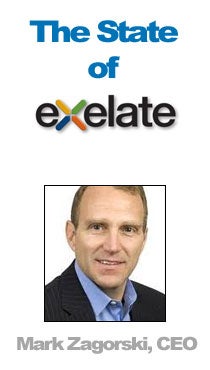
The State of eXelate: CEO Zagorski On The Exchange, maX Data Product And Programmatic Buying Trends

State of eXelateMark Zagorski is CEO of eXelate, a data marketing technology company.

As part of its "State of..." series of articles with industry executives, AdExchanger.com spoke with Zagorski to discuss his company, his views on the space, and the state of eXelate today.

Click below or scroll down for more:

AdExchanger: What's the latest on the eXelate data exchange strategy?

MZ: To put it quite simply, our driver is to help marketers make better digital advertising decisions. And we're doing that through providing unique and proprietary data at scale. The unique data by creating exclusive relationships with offline data partners, online data providers and the proprietary being to create custom modeled datasets so those advertisers can better target audiences based on their specific needs. So the exchange is more or less a means to an end for us and that end is helping advertisers and marketers drive better digital advertising decisions.

Does the exchange model exist today with eXelate?

Yes. The concept of an exchange can be taken in a lot of different ways. We still have a model in which there are buyers and sellers of data. Data, in which we ingest, segment, score and deliver - so that the exchange to which we're connecting can absolutely exist. Where it starts to morph into something different is the concept of creating a private exchange. It's how we connect specific buyers to specific sellers in their own proprietary relationship. And then the concept of not just connecting a buyer and seller of a constructed piece of data, but also taking that data and building something totally new out of it.

So, where an exchange or a marketplace considers the idea of someone bringing a product in and selling it directly to a buyer, we're now moving into a world in which someone brings a product to it.

We sell it to a buyer, but we can also take that product and make something totally new out of it, then sell it to a different buyer and create greater value across the board - both for the people that brought the data to bear, as well as for the buyers themselves.

Looking at it from an industry-wide perspective, what would you say about current momentum in the real-time bidding or programmatic world?

Read the rest of this entry »

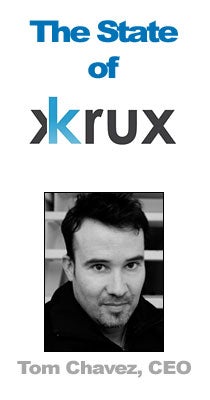
The State Of Krux: CEO Chavez On Apps, Ecosystem And Moving From Defense To Offense

State of Krux DigitalTom Chavez is CEO of Krux, an online advertising technology company.

As part of its "State of..." series of articles with industry executives, AdExchanger.com spoke with Chavez to discuss his company, his views on the space, and the state of Krux today.

Click below or scroll down for more:

AdExchanger: From an industry perspective, it seems there's been a lot of churning going on - companies are pivoting, executive shifts. Some companies are getting acquired. What's been your take on this?

TC: What goes the furthest distance towards explaining all of that churn is the simple reality that there are too many hangers‑on trying to skim revenue between advertisers and publishers. This has been talked about for quite some time. What we're starting to see are the early phases of either consolidation or just a general cleaning up in the middle of the Kawaja chart. That's the first thought that comes to mind.

The second thought that comes to mind is that we see a lot of coming and goings in the executive ranks - publishers especially. What goes the farthest distance towards explaining that is that, first, publishers aren't claiming their fair share of the revenue from all of the content and audience experiences that they invest so much to create. In those organizations, you see a shift now to try to right the ship and make some moves to try to fix it. I'm not sure that we see a lot of intentionality or strategy behind that. It's more of a thrash, which is unfortunate for everybody.

But, in some cases, you do start to see the early glimmerings of some media companies now trying to figure out what they have from a competitive perspective, their strongest assets, where they can play in a broader advertising environment that has been overtaken not just by search, but increasingly automated via exchange space methods for display. Here, the elephant in the room is obviously Google. My own two pennies here is that Google has utterly just crushed it in display exchange. They took a $100 million business and have turned it into a multi‑billion dollar business in an astonishingly short period of time, which obviously puts competitive pressure on publishers who are trying to figure out if they want to play in that arena.

Increasingly, I'm not sure that they have a chance. They're trying to hold the line and ring‑fence their direct sale business and claim full value in that sphere but going back to the publisher or media perspective, "What do I have? What is my strongest asset?" You expect me to point out that it's their audience data. It's data that has the possibility, now, of fueling not just advertising experiences but more interesting content, commerce, collaboration, selling and marketing experiences. The acquisition of SAS by aiMatch could be evidence of SAS' interest in advertising, but I really don't think so. We're in an environment now where companies like SAS are looking at ad servers like aiMatch and saying, "You know what? That's an interesting tunnel, an interesting bridge between companies and web experiences with consumers that aren't necessarily tied to ads." The ad server in the new regime becomes what you might think of as an engagement server.

Read the rest of this entry »

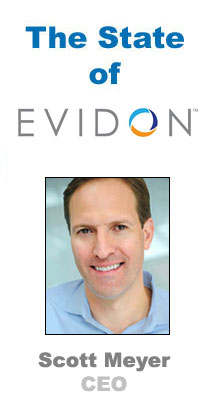
The State Of Evidon: Meyer on Regulation, Extending Into Performance and The Roadmap Ahead

State of EvidonScott Meyer is CEO of Evidon, an online advertising technology company.

As part of its "State of..." series of articles with industry executives, AdExchanger.com sat down with Meyer to discuss his company, his views on the space, and the state of Evidon today.

Click below or scroll down for more:

AdExchanger.com: Where do you think we are with the online ad tech space today, generally speaking?

SCOTT MEYER: There's totally an inflection point. I've been at this a long time and I think this is the third wave, if you will. There was the first big bubble, and then there was the second one, and you can see that we're reaching another crescendo. The apex of it is still a year to 18 months away. What you're starting to see now is a pattern that has repeated itself in the past, and it will become apparent this year, which is the separation of the great from the merely good.

You're going to start to see companies that are accelerating. And as we've seen, the creation of RTB technology shows how easy it is to get into the market now with the readily available, venture capital.

So, in each category you're going to see who the market leaders are. The other ones are not going to fade away, but they'll consolidate.  That's the big picture thing that I see going on.

What keeps Evidon safe from a world of commoditizing technology?

In order to be the company that we are - doing compliance and transparency - it's very hard to be credible unless you're very cautious to never be seen as going into competition with your clients, right?

That's why we never trade in any form of media or data. We just don't. We've been around for more than two years, and everyone has seen that being a technology platform for compliance and transparency is a great business. No one's worrying anymore about, "Oh, what's the Evidon pivot? What day are they going to show up and say, ‘We're now the Evidon ad network? Thanks for trusting me with all your data.’" Frankly, that was written into our contracts with all of our clients from the beginning and was never an issue.

Read the rest of this entry »

      © Copyright 2012 AdExchanger.com. All rights reserved.
      Terms Of Use      Privacy Policy      Contact Us