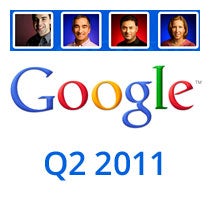
 Google released second quarter 2011 earnings today as the company made tons of cash: “GAAP operating income in the second quarter of 2011 was $2.88 billion, or 32% of revenues.” And a new record of $9 billion in revenue in the quarter. Read the release. And, get the earnings slides (PDF). Google AdSense saw 20% growth in overall business as “network revenues” achieved $2.06 billion. Bloomberg reports that the revenue and earnings achievements beat all estimates by Wall Street analysts.
Among the notables on the earnings call were CEO Larry Page and SVP of Advertising Susan Wojcicki. SVP and Chief Business Officer Nikesh Arora indicated display ad growth has occurred across all applicable Google channels and expressed happiness with its Invite Media acquisition and looked forward to the closing of the Admeld deal announced in June. In regards to customer support, Arora noted Google’s focus in this area beyond initial onboarding. This is always a ticklish subject as agencies are wary of Google overrunning them.
Wojcicki took over on the call after Arora to tell the ads story. She made the case that display advertising is moving to a “scientific” model with real-time bidding and indicated 5x growth at demand-side platform Invite Media year-over year and, moving to AdMob, the mobile ad network is experiencing 3x growth YOY. No mention of guaranteed sales through Google Display Network Reserve product like the last call.

Later during the Q&A on the earnings call, Wojcicki admitted that Google+ “signal” will be used to help target ads among other methods such as contextual and interest-based targeting. Most all of the questions on the conference call were softballs as Wall Street likely didn’t want to piss off Google’s new CEO.
In answer to a question from UBS analyst Brian Pitts about rich media ad formats, Wojcicki stressed clickthrough growth as a key success metric in understanding how its new rich media products are performing and serving the user. Later, in describing the local ads opportunity, she said that the large national retailer and the local, hometown retailer create two different challenges which Google is addressing separately. For local, she announced “Google Boost – a one-minute, 5-page process” for the small retailer to sign up for AdWords. So, there’s a landing page optimization program at Google!
JP Morgan’s Doug Anmuth asked about whether Google would need more owned and operated display ad inventory to which Wojcicki responded that YouTube remains big and growing. She said the display strategy is dependent on “the platform” which brings advertisers and publishers together. So, no one wanted to talk about more O&O inventory today.. but those days are coming as Google morphs into a media company more and more. Unique, compelling content will be the new differentiating technology.
Wojcicki added that CPC drivers included foreign exchange, quality improvements with the ads particularly above organic search results. Above-the-fold, top of the page is an expensive CPC!
The overall topic of the call’s Q&A: Google+. What does it mean? Will it impact overall Google strategy and revenue and when?
As for Larry Page’s performance on his first second earnings call as CEO, he speaks with a surprising humility and is articulate. If I had been there for the after-call party, I would have given him a big hug. It will be interesting to see if this hardens over time – his attitude, not mine.
The replay of the earnings call will be available on YouTube here.
You can read the entire conference call transcript on Seeking Alpha here.
By John Ebbert