
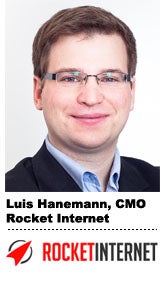
 Berlin-based Rocket Internet incubates e-commerce startups in markets outside the US, running them first as closely held businesses and then encouraging greater autonomy of operations and marketing in advance of a potential sale. As such the company is a big proponent of retargeting and was an early adopter of Facebook’s ad exchange.
The company leaped into FBX immediately after the RTB platform launched officially last fall, and now works closely with FBX specialist Triggit across many of its brands. Rocket Internet’s Chief Marketing Officer Luis Hanemann recently spoke in depth with AdExchanger about its display ad strategy and how FBX fits in.
“For us Facebook Exchange is mainly about reach,” he said. “But there are many areas for improvement. A question we ask Facebook is, will there be the possibility of using data they have as well? Right now there’s no interconnection of FBX with information Facebook has about its users. That’s interesting.”
Back Story
Rocket Internet was founded by the German brothers Oliver, Marc, and Alexander Samwer. Among its ventures are European shoe e-tailer Zalando; Foodpanda, a food delivery service focused on Eastern Europe and Southeast Asia; Russian fashion e-retailer lamoda; and many others. Its exits have included Tradoria (sold to Rakuten), Jamba (sold to Verisign/News Corp), and Alando (sold to eBay).

Hanemann runs strategic marketing functions for the brands. That includes managing relationships across global media platforms, such as Google/DoubleClick, Facebook, and others. He and his team tend to focus intensively on building up new ventures before handing over the marketing reins. Its recent focus has been on Nigeria-based Jumia, a general online retailer that he describes as a mixture of Zappos and Amazon.
“All the marketing is done by Rocket employees in the beginning. Step by step we’ll build up their own team and we move into a more strategic role,” he tells AdExchanger. “We phase out after a while.”
Many Countries, Many Partners
Rocket Internet works with many vendors. Its platform strategy is divided between large global players, category specialists, and regional partners. For search, it primarily uses Adobe/Efficient Frontier and Kenshoo. Commission Juntion is its preferred affiliate platform, and it works with Facebook and Google in virtually every country where they operate.
And it fills in the blanks when its preferred vendors lack a robust solution. For instance, retargeter Criteo is a key partner, but Hanemann says it is not strong in Africa, where he seeks other solutions.
In the display media area, Hanemann says, “Display for us is more important than for other companies. We always have to be one of the marketing leaders in a very short time span. Even if search gives us a better ROI or direct impact, we invest a lot in display marketing to grow our companies in a way that they’re market leaders in a short timespan.”
The company’s display ad spend is focused on performance, even when it’s not measuring clicks. “We invest a lot in business intelligence and making sure we understand the whole customer journey,” Hanemann says.
The company is an active retargeter, which is no surprise in light of its e-commerce focus. It works mainly with Sociomantic, its neighbor in Berlin, and Criteo. And now, with the rise of FBX over the last six months, it has opened a new line item in its retargeting scheme, working primarily with Triggit.
But it didn’t start out that way. Rocket worked initially with AdRoll, buying its first FBX impressions in Australia starting around September – right after the platform launched. “As we were very strong with retargeting in general, we were really keen on starting with the Facebook Exchange,” he said. “We were always asking them when it was going to start.”
Later, the company signed a corporate deal naming Triggit as a preferred partner. It had one venture working with the company, and one with AdRoll, Hanemann said, and during that trial it saw better results with Triggit. It signed a preferred partner contract with Triggit around December that was implemented across numerous brands beginning in January. However it still works with AdRoll on about a dozen of its properties.
Rocket Internet declined to share performance and ROI results on FBX, only saying that “it works quite well” and provides roughly the same impact relative to standard retargeting. The real value is the enhanced reach possible through FBX as Facebook commands an ever larger share of global impressions.
The company also does considerable programmatic buying outside the retargeting space: enriching online data with its own CRM data, and then using RTB to reach lookalike audience segments.
Facebook And The Future
Hanemann sees the emergence of FBX as only the latest stage in what has been a continuous evolution of the Facebook ad platform. “At the beginning, it was a very cheap method of getting tons of traffic. But that changed after a while, as CPCs rose and Facebook introduced an auction model,” he said, “Today, in some markets, you can’t do marketing without Facebook.”
Morocco, for instance, is one country where he says Facebook is the Internet. “That was interesting for us because in Germany you could do marketing without Facebook. In some Asian or North African countries it is so popular that without Facebook you couldn’t be a successful online.”
The next natural step for FBX is to integrate Facebook data and increase the ability to infer interests and intent based on available data. “Today we start with the basics, but there are more possibilities,” Hanemann said. “If you’re interested in this kind of product, maybe you are interested in another product.”
The story was updated with more specifics on Rocket Internet’s relationship with AdRoll.