

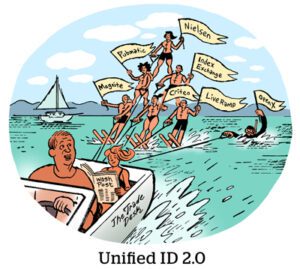
 The Trade Desk and Adobe Experience Cloud announced a partnership on Thursday to sync emails stored in the Adobe CDP product with The Trade Desk, which converts the emails into Unified ID 2.0 (UID2) IDs that can be traded programmatically.
Advertisers and publishers have moved away from DMPs and other cookie-based advertising ID solutions in favor of customer data platforms (CDPs) and other data services to store first-party data, said Ben Sylvan, The Trade Desk’s GM of data and retail partnerships.
“As advertisers shift their focus to CDPs and other tech to host their CRM data, it’s really important to continue to bring that data into The Trade Desk,” he said.
In much the same vein as what’s happening with the Adobe CDP now, the UID2 program added Snowflake as an integration partner last year, going straight to the brand’s first-party data service.

The Adobe CDP integrates with other ad tech companies and identity services so that audiences built by advertisers using the CDP can be activated elsewhere. But this is the first occasion where email data is being transferred to a programmatic ID outside of Adobe, said Sahil Gupta, director of business development for the Adobe Experience Cloud, which houses Adobe’s CDP product.
Talks between Adobe and The Trade Desk began a year ago, Gupta said, but it took months to finalize how the transfer of data and conversion to IDs would work. In other words, the duo needed to consider consumer privacy standards. The two companies are still working on a product that would feed results from campaigns using those IDs back to Adobe for analytics and optimization.
If an Adobe client requests that the personal information of its customer be deleted, for example, or revokes consent to use the data for advertising purposes, Adobe needs to be able to reel those requests back throughout the UID2 system as well as The Trade Desk itself. Although it’s backed by The Trade Desk, UID2 is now a standalone open-source group whose code is hosted by The IAB Tech Lab.
Regardless, the email data is now an ad ID.
“What we’re bringing together in terms of making first-party data that isn’t backed by cookies available for scaling in a programmatic channel feels like charting a new course,” Gupta said.
It’s akin, he said, to how Google and Facebook have excelled by backing their ad IDs with email data and successful CRM onboarding services (Google Customer Match and Facebook Custom Audiences, respectively).
The Trade Desk is the closest to matching that scale across the open web on the buy side, Gupta said. And scaling a buy-side service, especially in CTV where email data is a “durable identity backbone” since there aren’t cookies, is no easy feat, he said.
The Adobe CDP and The Trade Desk also share many clients, Gupta said, “and The Trade Desk is where we’ve seen those folks getting ready for this new world.”
In theory, another DSP that integrates with UID2 and has built its own tool to convert Adobe CDP emails to UID2 IDs could also tap into the Adobe data set, Sylvan said. However, he said The Trade Desk is the first activation channel for CTV working with Adobe CDP emails, outside of Adobe using IDs within in its own platform.
“Advertisers’ first-party data is the most valuable data set,” Sylvan said. “That data is primarily stored now in various cloud databases, whether that’s CDPs or clean rooms, and we want to continue to break those silos and create harmonized marketing campaigns.”








