

As Twitter’s video ad business grows, so does the amount of user-generated content on its platform. The challenge for Twitter, and brands that advertise on it, is to keep brands safe from, well, the Internet.
In April 2018, 50% of Twitter’s business came from video advertising – and that still holds true today. In Q1 2018, the company made at least $287 million from video ads, according to Recode.
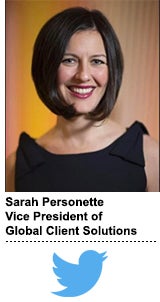
AdExchanger caught up with Sarah Personette, Twitter’s VP of global client solutions at this year’s CES in Las Vegas, to learn how the social media giant plans to grow its video ad business even more in 2019.
AdExchanger: What’s the current state of video advertising on Twitter?
SARAH PERSONETTE: The world has become mobile, and mobile has increasingly become video. We made a pretty significant investment in making our video products stronger, better and more performant. And with that, in-stream video sponsorships, in-stream video ads and website video cards are driving the bulk of our business.
Over 50% of our business is coming from video at this point. We believe that this will continue into 2019 as consumer behavior shifts there, but also as the demand from brand advertisers continues for using video to tell great creative stories. But [they] also want brand-safe, premium quality, scaled content that they can integrate their brands into, which is what our products offer.

With so much user-generated content on Twitter, what are you doing to help brands ensure their content stays safe?
There are a few ways that we do this. One is from a machine-learning perspective, making sure that we have the right tools and protocols in place to provide the right type of environment for [brands].
We also [ensure brand safety] from a content perspective. We have over 950 content partnerships right now that we’ve done in 2018 alone, and we’ve just launched five more partnerships at CES. The integration of brands into this brand-safe content, where they can choose which publishers they are associated with or which genres of content they’re associated with, also ensures a brand-safe, high-quality premium video environment.
What do some of those video partnerships entail?
On Monday we announced a partnership with PGA. We’re extending our coverage into the weekends. On Tuesday we launched our partnership with Fox Sports and the Women’s World Cup in Paris. I’m particularly excited about that because it helps to celebrate women in sports.
We have also launched with BuzzFeed. We are continuing a renewal of “AM2DM.” It’s an incredible example of a publisher understanding the fast, fun, real-time conversant nature of the platform, and they do it exceptionally well.
We also announced a partnership with The Ringer. We have done some work with them on “Game of Thrones,” and we’re also taking that to another show, “Big Little Lies.”
With all these new partnerships, are you thinking about any new ad units you’re going to roll out?
Not at the moment. Our ad units, between the in-stream sponsorships and in-stream ads, are doing exceptionally well for advertisers, so we’ll continue to focus on building the best, most performant tech stack to help propel that inventory forward.
Do you plan on doing anything in the programmatic space more in 2019?
Not at this time.
What do you think is the most powerful aspect of Twitter for advertisers?
The power of Twitter is our audience. It is the most leaned-in, receptive and valuable audience, because Twitter is what’s happening. We’ve found that our advertisers are really successful when they’re launching something new on the platform and when they’re connecting with what’s happening in the moment.
Our advertising capabilities are designed to drive business objectives across the entire purchase funnel.
What are some of your goals for 2019?
We want all advertisers to understand the power of our audience. When they are launching anything new, whether it is a product, campaign or a feature, they can come to Twitter to find the most leaned-in audience. That is the No. 1 most important thing we can do and accomplish in 2019.
We know that it works. We know that we have 2x the ad recall, we know that we drive 40% better sustained awareness, and we have repeatable, predictable ROI at $3.36.
The second most important job to be done for clients is connect to the moments that are happening in real time, the cultural movements that are occurring on the platform, driven by the people on the platform. This is a platform that moves at the speed of culture and conversation because of the people who power it. We work with brands every day to help them connect with what’s happening so that their brands can be the most resonant and resilient in the marketplace.







