Branded Entertainment Network (BEN), an LA-based agency that specializes in product placement and influencer marketing, wants to bring a more data-driven approach to Hollywood brand marketing.
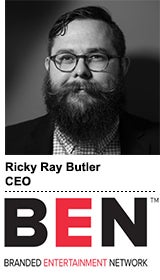
Last March the company promoted Ricky Ray Butler to CEO, three years after adding Butler with the acquisition of Plaid Social Labs, the social marketing tech company he founded.
BEN added costs with the acquisition, but the combined business grew 54% last year, and this year will be the first when it is profitable, Butler said.
Driving BEN’s growth is a more integrated approach by brand marketers, who are breaking down category barriers between film and TV production vs. streaming or online video, and they are now applying analytics to Hollywood deals.
AdExchanger spoke to Butler.

AdExchanger: How is your business split between the longstanding Hollywood and studio branding deals and influencer marketing?
RICKY RAY BUTLER: The business is about 50-50 now between studio product placement and influencer marketing. But we don’t see influencers as such a different category or just in terms of deals with celebrities, which is how a lot of that brand endorsement works.
We see influencers essentially as TV. A younger person may watch more video content on YouTube and social media than they even do on Netflix.
If we’re working with a brand, for example, we might guarantee some hundreds of millions or a billion impressions in a year. For that we want a hybrid approach, where we run a variety of influencer campaigns and work with a mix of studio productions on brand integrations.
What do you think about the potential for automated product placement – going back and putting a Pepsi can on a table, say, or the ability to insert different brands based on the viewer?
There’s a place for that to be sure. But our whole argument is you want to make sure to be a part of the storyline and content, instead of discreetly in the background.
The post-edit technology for adding a brand seems like scraping the bottom of the barrel. The premium integration is being a part of the storyline or having something around your product in the show.
Who do you most closely compete with?
On one side are holding companies and some specialized agencies that do influencer and endorsement tie-ups.
The more traditional set is Hollywood shops that have been working on product placement for decades and are integrated into studio production. We compete there and have for a long time.
But those companies are typically limited in scale. They don’t really operate outside of Hollywood, and they don’t have the online, algorithmic extension of the business. We bring more of a technology-based approach, like guaranteeing certain digital-style metrics.
What are the performance metrics and attribution brands want to see from these kinds of deals?
It can range quite a bit. Some people want to see traffic or impressions and others are measuring brand lift. On the digital side we measure conversions, like a sale or a call to action that influencers can include.
Attribution is specific to the brand. Some household brands, say, may just want to be a part of heartwarming family moments. But certainly there’s more data being brought to bear.
This space has so much unstructured data – not the impressions or views kind of data you get back from a platform in spreadsheets. The unstructured data is like the kind of placement and context of show or movie. We have that unstructured data and can do predictive modeling for brand lift or sales based on a product integration.
I think you’ll see more opportunities for that open up. Amazon, in particular, is going to be going beyond the impression and view data to more accurately predict sales and outcomes.