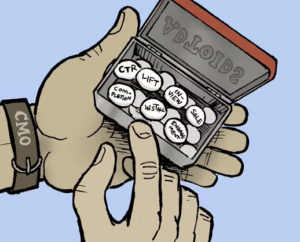
 While Rocket Fuel’s Q3 revenue missed its guidance, CEO Randy Wootton emphasized the company’s continued transition from an ad net into a platform solutions provider.
Rocket Fuel’s Q3 non-GAAP revenue of $62.3 million was down 8% compared to last year, while its GAAP revenue of $109.7 million was 2% lower year over year (YoY). Read the release.
If Rocket Fuel fulfills its goal to return to profitability by 2017, it will have done so by attracting larger customers who spend more – as opposed to the many smaller clients it used to work with. Meanwhile, Rocket Fuel will be taking much less margin as a platform company than it did as a media services provider.
“I want to underscore the point that we’re laser focused on controlling our costs and emphasizing the business model structure for transforming our business,” Wootton told AdExchanger before Rocket Fuel’s Tuesday earnings call.
Rocket Fuel’s Q4 earnings will likely reflect that transition. It expects non-GAAP Q4 revenue between $57 million to $62 million, due to an anticipated seven-point margin decline as more customers move from Rocket Fuel’s media services to its platform solutions. The company has also had a handful of clients move from variable to fixed margin media services – and more might follow.
Despite the margin hits, Rocket Fuel’s Q3 year-over-year declines are actually due to surprisingly low political ad spend, the result of 2016’s bizarre election cycle. Rocket Fuel also had a slowdown in EMEA business – particularly with the UK.

“We see the consolidation of spend there that we weren’t seeing a year ago,” Wootton said. “I think some of the spend in the UK can be associated with uncertainty around Brexit, though I can’t point to anything exact.”
On the bright side, the platform solutions business continues to hum along – with GAAP revenue up 141% YoY and representing 19% of Rocket Fuel’s total revenue, compared to 8% last year. In Q2, platform solutions constituted 18% of Rocket Fuel’s total revenue.
Another positive: The three prospective holding company deals Wootton discussed last quarter will soon bear fruit.
Rocket Fuel recently signed with one (unnamed) holding company, Wootton said, but that deal is still being activated and isn’t reflected in Q3 earnings. Media spend from independent agencies trailed off during Q3, leading to a 3% YoY decline in Rocket Fuel’s North America GAAP revenue to $90.9 million. It’ll take a quarter or two before Rocket Fuel’s earnings reflect the new holding company deal, Wootton said.
Wootton wouldn’t elaborate on the status of the other two holding company trials, other than to say they were going well. Both trials mark a shift in the company’s traditional relationships with the agency world, once slightly contentious because of the high margins Rocket Fuel generated for itself. That has changed.
“[The holding companies] see us coming forward with a solution orientation to make them successful,” he said.
So Rocket Fuel’s intent to be profitable in 2017 is still apparently going as planned, though Wootton wants to add more color to the Q4 earnings.
“Our future is in the platform solutions business, long-term relationships with a couple of the top holding companies, independent agencies who get digital and big brands who like lots of data,” Wootton said.
Rocket Fuel also brought on Adobe and HP vet Stephen Snyder as CFO, succeeding Rex Jackson. Jackson, appointed just last March, resigned to join another company.