“Data Driven Thinking” is written by members of the media community and contains fresh ideas on the digital revolution in media.
Today’s column is written by Lung Huang, vice president of digital advertising and global partnerships at dunnhumby.
In The Wizard of Oz, Dorothy asks the wizard if he has ever been frightened. The Great and Powerful Oz responds, “Frightened? Child, you’re talking to a man who’s laughed in the face of death, sneered at doom and chuckled at catastrophe…I was petrified.”
Oz’s brazen attitude offers an important lesson for modern-day marketing. It’s not his all-green attire that deserves respect from the marketing community but rather his action in spite of his fears.
In our industry, the volume of data is growing by leaps and bounds, rushing forward with such momentum that, frankly, it scares everyone from the highest-level boardroom executives to junior analysts in the deepest, darkest cube farms.

But this data is not an unwieldy monster; it’s our new neighbor. It is, as TRA CEO Mark Lieberman calls it, “naturally occurring data.” It’s part of advertising, media planning and marketing, and it’s here to stay.
Yet in response to all of this momentum, our industry seems to be petrified into a standstill. We’re doing nothing but talking about this data. At the recent ad:tech conference in San Francisco, many people spoke about Big Data and its implications for the future, but how many are actually applying those ideas today? We’re not interested in exploring alternative models or processes that Big Data enables; we want to limit its influence and continue to do more of the same.
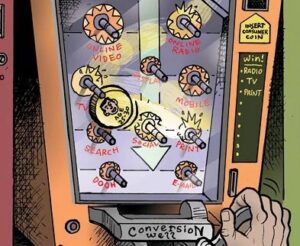
One topic that sparked much discussion at ad:tech was media attribution in the digital or broadcast world. We stand at the dawn being able to actually connect an exposure with a purchase, a game changer for certain digital marketing categories.
In the next few months, we’re likely to see more digital and television plans that include more data, many of which will aim to show a direct connection between exposure and sales behavior. Of course, that is easier said than done. If harnessing this data was as easy as making the statement “We need a direct connection between media exposure to offline sales,” I would’ve dropped my microphone at ad:tech and exited stage left to great fanfare.
This process involves many stakeholders who need to know not only how this connection will impact them but also how and where to use this new data. The data providers, publishers, broadcasters, advertisers, agencies and analysts need to know and truly believe that the game has changed. Those who have seen the light (including the data-driven marketers reading AdExchanger) can help. It is our job to explain the possibilities of using this data to those who are still in the dark.
The bottom line: Media and planning models are no longer spray and pray. Consumer products can no longer rely simply on media mix modeling, given that the original objective of media mix modeling was to see which media was most effective in terms of sales. The granular data is now available, and using it only within the same old model doesn’t seem relevant.
We can start understanding results based on the longitudinal nature of a consumer’s purchase cycles. We all have a chance to prove that the advertising plans we put into the marketplace has yielded results – actual results – and we don’t need a model or a T score to prove its significance.
This is no time to be petrified into inaction or to dismiss a new process due to lack of information. I’m willing to explain the promise of media attribution to anyone who really wants to know but is afraid to ask. Because I retire in the next few years, I want to live in a marketing world that doesn’t rely on the “adults 18-49 demographic, the most coveted target for advertisers.”
I’m ready. Are you? We won’t need to click our heels to get there, because it turns out we’ve been there all along.
Follow Lung Huang (@Lung_Huang) and AdExchanger (@adexchanger) on Twitter.