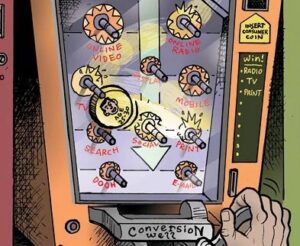
We’re going back to the basics in 2023. After a few years of big spending on brand campaigns and doing test drives of emerging channels, inflation and recessionary pressures mean pumping the brakes on superfluous spending and the nice-to-haves. Here are the key trends I see driving digital marketing in 2023:
Spend shifts from branding to performance
Many companies are shifting the money from big brand campaigns slated for Q4 to search, demand generation or performance-driven channels. This type of reallocation will be the rule in 2023. Marketers will be hesitant to do the kind of expensive, mass branding campaigns we saw frequently over the last two years. Of course, some of the largest names will continue to spend a lot on brand advertising. But for the challenger brands, those in crowded spaces and the DTC brands, we’re going to see the focus shift to measurable results.
As part of this shift, marketing departments and brands may need to restructure and retool their talent pools. They’re going to need to bring in more people focused on demand generation. Performance campaigns are going to provide the “insurance,” so to speak, by showing business leadership that they’re getting ROI with their marketing spend.


Brands turn to hyper-targeting to drive efficiency
When things get tight, everyone focuses on making their spend go further. Hyper-targeting will drive efficiency in 2023. We’re going to see more brands focus on smaller groups using targeted audience data so they can get more bang for their buck. Very specific, micro-targeted segmentation will reduce waste by removing the people that are not likely to buy.
To get to this level of hyper-targeting, media buyers will use more customized data instead of off-the-shelf data. Media buyers are going to create more custom audience segments that can deliver greater efficiency and effectiveness for brands.
Action-oriented sequencing in omnichannel campaigns will emerge as a related minitrend. For example, brands traditionally keep the audience the same across channels. They hit the same audience with direct mail, display, connected TV, etc. But to get more efficient, we’ll see brands use action triggers to hone their focus as the campaign progresses through touch points. Engaging with the display ad will lead to an email; those that open the email will trigger Google AdWords, for example.
Detailed measurement becomes the must-have
Marketers are going to be accountable for showing measurable results and ROI – and continually showing improvement in these metrics.
At a fundamental level, we’re going to see a lot of rethinking of the criteria that marketers are using to judge campaigns. Should it be sign-ups? Sales? What constitutes “success” or “conversions”?
And on a functional level, end-to-end reporting is going to move from a nice-to-have to the essential must-have. The superfluous money that’s flowed through marketing teams the last year or two is going to stay behind a dam until the general state of the economy improves. Until that happens, marketers are going to be under much greater pressure to show the CMO, the CEO and the Board that X dollars in spend directly generated Y dollars in revenue.
Email undergoes a resurgence as an acquisition marketing channel
Marketers are rebounding from “emerging channel fatigue.” They’ve felt the pressure to chase the new channels, like TikTok, Snap and Reddit, without seeing the results they get from tried-and-true channels like email, search and remarketing.
Email has largely been overlooked over the last few years, but we’re going to see more companies using email in conjunction with connected TV, AdWords, etc., to help drive reliable responses. There’s an immediacy to email that drives its effectiveness: The audience receives a personalized message and can engage and convert in real time. That’s something you just can’t get with a print ad, or even with a display ad.
What should brands be doing now?
You can’t abandon brand advertising – it’s still important. But brands need to invest more in performance marketing and go beyond generic, off-the-shelf audience data. Prove performance to stakeholders and don’t succumb to the pressure to always chase the “new hotness.”
There’s a lot of anxiety swirling due to the current macroeconomic climate. But brands and marketers should view it not as a recession but an opportunity to reset.