
Here’s today’s AdExchanger.com news round-up… Want it by email? Sign up here.
A Safe Bet
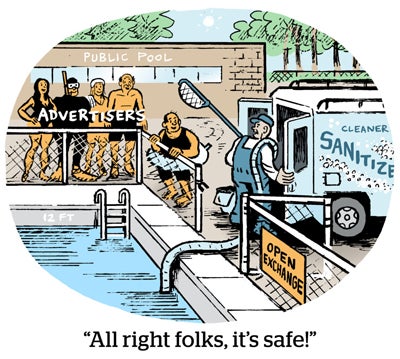
Which is “unsafe,” really: the tech or the media?
Advertisers think of “brand safety” as an adjacency issue.
Is there a picture of a car crash? Maybe not Toyota.
Other brands avoid keywords like “gun control” and “abortion.”
But there’s a “growing chorus” of online ad industry insiders pressing for brand safety to reflect the content and organizations that advertisers support with their dollars, writes Krzysztof Franaszek, founder of Adalytics, at the ad tech blog Transmit.
Google, for instance, was spotted serving ads to site operators explicitly cited on the United States Treasury sanctions list due to known links to Russian intelligence services.
OK, that’s not great. But, somehow, ads served to critical, hard-earned news reporting on abortion issues that are near to the readers’ hearts and minds are often promptly flagged and the ad channel cut off. Bad-actor sites know how to play the programmatic game and maintain pages free of adjacency errors.
“If advertisers wish to avoid these brand safety risks, they must hold their vendors accountable at a systemic level, rather than playing catch-up or engaging in a ‘whack-a-mole’ with domain exclusion lists,” Franaszek writes.

Split Clean In Two
Google pens a blog post saying it’s “introducing two new solutions powered by Ads Data Hub.”
A Google Translate from Content Marketing to English shows they mean to split Ads Data Hub into two distinct toolkits, one for measurement and one for ad-buying and audience targeting services.
Google invented the data clean room category with ADH. In January 2017, AdExchanger was the first to pry the words “Ads Data Hub” from a Google exec.
Initially, ADH only provided measurement information. Its reason for being was YouTube. Once YouTube was linked with Google Search data, the clean room prevented any user-level data from being leaked via measurement exhaust. But then ADH became Google’s vehicle to commingle data from Chrome, Android, Maps, Search, YouTube, etc., for advertising. Campaign data was matched to Google IDs and advertiser first-party data onboarded to Google Cloud.
In 2020, ADH began audience activation tests with the Google DV360 DSP.
The split seems innocuous, but Google needed to divide ADH for Measurement Partners and ADH for Marketers.
The marketers’ version includes audience activation and will be Google-centric. Since it uses Google’s ID graph, no outside DSP can touch it. It also by definition funnels to Google-owned media. Bundle in ADH’s awkward status as a Google Cloud product (forcing cloud accounts), and it’s an antitrust quagmire.
Also, by dividing the two, the measurement version can be in line with emerging open industry data clean room standards.
Elongate … The ‘Gate’ That Never Ends
Elon Musk’s Twitter takeover was finalized over the weekend, and at least one advertiser already stepped out for coffee.
GM, rival of Musk’s electric car company Tesla, temporarily suspended advertising on Twitter as it evaluates the platform’s new direction, CNBC reports.
Musk promised to overhaul Twitter’s content moderation policies, including permanent bans on accounts like President Donald Trump’s for misinformation and policy violations.
But not every advertiser with cold feet about Twitter will be a direct competitor of a Musk-owned business. He does invite, shall we say, brand suitability concerns. Especially considering he’s been adamant that Twitter’s content moderation should reflect his views.
On Sunday, Hillary Clinton took to Twitter to blame Republican Party rhetoric for a recent assault on House Speaker Nancy Pelosi’s husband. Musk responded to Clinton by sharing a news article and publisher that betrayed very low media literacy. Musk deleted his response to Clinton, but he’s not actually capable of owning the mistake, so he lashed out at news publishers for calling him out.
Luckily, it’s only one week before the US election. But weep for whoever must ready Twitter’s moderation and misinformation policies in the run-up to the 2024 presidential cycle.
But Wait, There’s More!
News aggregators aren’t growing like they used to, but publishers still see their value. [Digiday]
Experian tool exposed partial Social Security numbers, risking customer re-identification. [CyberScoop]
For Hollywood talent managers, booking gigs is no longer enough. [Bloomberg]
Google intros new Google Analytics for Firebase solutions for web-to-app tracking. [blog]
The problem with too much data privacy. [Time]








