
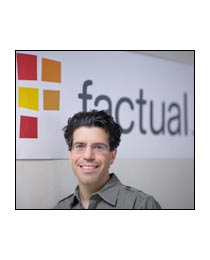
 Gil Elbaz is CEO of Factual, an open data platform.
AdExchanger.com: Looking at your experience when you sold Applied Semantics to Google (which became AdSense), what is relevant today with Factual?
GE: Applied Semantics was founded to develop and take advantage of it’s natural language understanding technologies which extracted meaning from unstructured data, and AdSense ended up being the killer app. Factual is also building a core technology around aggregating and cleaning facts from a variety of sources in a variety of formats (structured and unstructured). Certainly the experience is relevant, but the model here is quite different as we are offering tools to app developers who will innovate and create the killer apps.
What problem is Factual solving today?
In order to create useful, interesting consumer apps, developers need simple access to good, affordable data which can easily be integrated into their development stack. For example, within the Local vertical, developers have been challenged with finding a global data provider.

What are the evolutionary steps that you’ve taken in Factual’s business in the past couple of years? Has “big data” business evolved, in general?
We launched just over a year ago with interesting data across many verticals. We quickly realized we should focus our attention on certain categories where our data offerings are most useful and unique. This led to a recent launch of our Local data vertical in September, and we’re really happy with the response and the partnerships we’ve built. For example, Facebook is using our local data for Facebook Places in certain countries.
Given your broad scope of datasets – who isn’t in your target market? Is there any target market that is particularly “perfect” for Factual? Can you share a use case?
We did initially launch with a large number of tables across many categories, but we have been focused on data within certain verticals that we can improve via data QA, additional layers of data cleaning, and strategic partnerships. Local has been one key area for us. It’s a great target market because the current vendors don’t seem to be able to offer what we can: global data, high quality with regular refresh, accommodative licensing terms, fair pricing, and an innovative model in which we discount prices for partners that share back edits and other data.
How do you scale Factual? What’s the biggest challenge?
We believe we can apply all our core data structuring and aggregation technologies across many verticals. To scale, we will need to attract the best talent within two broad categories: engineers who can help further automate our large scale data aggregation platform, and domain experts within new verticals that can bridge the gap between technology and product.
How does/will Factual make money? Any future funding plans?
We have been refining our model. We know there is interest in a simple per-API call fee for data access, but our preference has been to explore more strategic relationships which involve our exchanging data value with select partners — we’re focused now on building a wholly singular and immediately accessible data-centric resource.
As far as fundraising, we just completed a $25 million Series A round last month and have not started thinking about future plans.
Who do you see in Factual’s competitive set?
This is a very interesting space, that is, providing data aggregation and data itself as a service. We see emerging competition coming from various dimensions, from cloud infrastructure providers, hosted database vendors, and legacy vertical data providers. But we also see opportunities for cooperation and partnership here.
Can you talk a little about what are the advantage of being a startup technology company in Los Angeles? Any disadvantages?
I’ve always liked going against the tide, especially when I have a hunch that the tide is turning. That’s the case today in LA where a new set of leaders have done remarkable things to show entrepreneurs that all the ingredients are here: talent, mentors, money, support networks. I’ve been really impressed, for example, that Mark Suster has worked so diligently and capably to promote and invest in this network. Also, Silicon Valley is starting to pay even closer attention. Consider Ron Conway’s SV Angel LLC which has recently invested in a number of LA-based startups.
Is there an application for advertising with Factual?
We’ve spoken to developers who are looking into using our data to help with targeting advertising, for example, for location-aware ads. But we haven’t been working on this directly.
What are your thoughts about the growing “exchange” model such as DoubleClick Ad Exchange or data exchanges like BlueKai and eXelate?
The ads ecosystem has grown impressively in power and complexity from the time I was deeply involved. I’m amazed by how much inventory a DSP (demand side platform) such as Triggit (in which I’m an angel investor) can see thanks to the various open ad exchanges. And, I’m equally impressed by the power of BlueKai’s marketplace for targeting data, and the degree to which it is positively impacting publishers and advertisers.
Can semantic technology effectively show intent in your opinion? Or is cookie-based data more informed.
There’s no silver bullet when it comes to understanding the mind of the consumer. Their virtual location on the web (current web page) is important and behavioral signals are also very significant. Now, with the incredible growth of mobile data, real-world location may become the key input into a targeting equation.
What are the milestones you would like the company to have achieved a year from now?
We’re focused on offering the best data accessed via the simplest integration path. We have an aggressive roadmap for both. We measure ourselves by taking the pulse of the developer community and hopefully, a year from now, they will see us as having made their jobs dramatically easier, at least within the Local data vertical.
Follow Gil Elbaz (@gilelbaz), Factual (@factual) and AdExchanger.com (@adexchanger) on Twitter.








