With the recent announcement by The Wall Street Journal and others that Google had bypassed the privacy settings on Apple’s Safari web browser, it raises the question, what would Apple co-founder Steve Jobs say about all this?
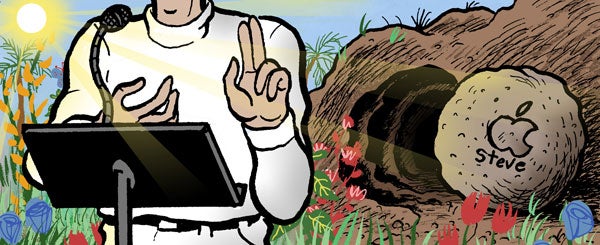
STEVE: Hi, everybody.
First, let me say, I’ve got a new company cookin’ here in the afterlife and we are about to launch some exciting new products that are due, in large part, to the incredible recruiting opportunity once you enter “the next phase,” as we call it up here. If you think you’ve got smart folks down there on earth, wait till you try “the next phase.” Einstein, Fermi, Newton – hey Jimi Hendrix is a helluva product guy. Anyway, more later from the PR team. There will be a press event in the third quarter. Stay tuned.
Now on to Google.
What a total lack of internal controls. If I was Larry – and I know Larry – I’d rethink my engineering mandate and start putting everyone on a leash, figuratively. Literally, if necessary. In every thing they do, employees and their managers need to be thinking, “Does this risk a lack of transparency with the consumer?”
Let’s be clear what the real problem is though. This isn’t just a Google problem, either. Down on earth, you all talk a good game about “big data”. Up here, we see even bigger “big data” coming – we call it “BFD.” And if you think predictive analysis is sharp now, predictive capabilities get freaky in 10, 20, 50 years…. Come on! -you think those Facebook ads are powerful because they’ve got your college in them or because some pants are following you around courtesy of the Doubleclick Exchange? Get real.

I could go on about the competitive elements here and how it pisses me off that Google is trying to screw me— (lightning bolt exploding) — but once you go to the “the next phase,” everything gets altruistic. So, here’s the deal: the further companies like Apple, Google, Microsoft, Facebook, IBM, Oracle, etc., take humanity inevitably down the path of analysis of BFD, the closer we get to predictive capabilities that threaten existing power beginning with the consumer’s rights, which is at the core of everything we do and build. Consequently, all of this data, cookie business, etc., just keeps getting more “radioactive.”
So, as this case with Google shows, if you’re going to get in the predictive biz – even if its just for ads – you need to put up some walls, a firewall for starters. Controls. I hear some of you – Battelle – snickering… sure, it’s great having a closed ecosystem to drive insane profits and piss off shareholders who want to nurse the dividend teet. But, what “closed” does is ensure that the thing works and sustains itself for the consumer. There are too many “variables” (“quote” signs with fingers here) otherwise. Closed is the new open – go ahead use that one, it’s a freebie. If we can’t control it – if I can’t control it – then there will be trouble.
Last night, Lincoln told me that the U.S. government will not take this latest cookie business lightly and could hamstring Google as it did Microsoft over its operating system monopoly. I don’t mess with Lincoln, but I think there’s a middle ground here. What Google is working with is part of the inevitability of our time. And, Google services are key to so many aspects of today’s connected, human life.
By the way, did I mention? Kubrick is big up here… he’s got a Gandhi vibe…
Therefore, given the value of Apple company stock and our $90+ billion in cash on hand, I’m authorizing – yes, Tim Cook and I still talk frequently – the acquisition of Google immediately.
Googlers, welcome to the fold.
Transcript provided by John Ebbert.